Argosy University Twin Cities closed in 2019, ending its 60-credit COAMFTE-accredited MA in Marriage and Family Therapy.
Degrees conferred while COAMFTE accreditation was active remain valid for LMFT licensure in Minnesota and other states.
Alumni can request official transcripts through the Department of Education's designated records custodian.
Prospective MFT students should now explore currently accredited alternatives such as programs at other Minnesota institutions.
Argosy University Twin Cities permanently closed in 2019, and its COAMFTE-accredited Master of Arts in Marriage and Family Therapy is no longer available. No students can enroll, and no new degrees will be conferred.
Before the closure, the Eagan, Minnesota campus trained MFT practitioners through a 60-credit clinical program that met licensure requirements in Minnesota and most other states. Graduates who completed the degree while accreditation was active still hold a valid credential, but navigating transcript access, degree verification, and post-closure licensure questions requires specific steps that many alumni find unclear.
For prospective MFT students searching for this program today, the practical question has shifted: which currently operating, COAMFTE accredited programs in Minnesota offer comparable clinical training at a justifiable cost?
Argosy University Twin Cities MFT Program Overview: History, Accreditation, and Closure
Argosy University's Twin Cities campus, located in Eagan, Minnesota, once offered a COAMFTE-accredited Master of Arts in Marriage and Family Therapy that prepared graduates for LMFT licensure across the country. That program no longer exists. The campus closed abruptly in March 2019 following a financial crisis at its parent company, and no path to reopening has materialized.1 If you are researching this program, whether as a prospective student, an alumnus, or someone evaluating MFT degree options in Minnesota, understanding the full timeline and institutional lineage is essential.
Institutional Lineage: EDMC to Dream Center
Argosy University operated as a for-profit institution for most of its existence. It was part of the Education Management Corporation (EDMC) portfolio, one of the largest for-profit education companies in the United States. EDMC ran multiple higher-education brands and enrolled hundreds of thousands of students nationally.
In 2017, EDMC's successor organization sold Argosy and several sister institutions to Dream Center Education Holdings, a nonprofit entity affiliated with a Los Angeles megachurch. The transition was intended to convert the schools to nonprofit status, but the deal quickly unraveled. Dream Center struggled financially, and federal regulators later identified approximately $13 million in misused federal financial aid funds.2 That mismanagement set the stage for the rapid collapse of every Argosy campus.
COAMFTE Accreditation and What It Meant
The MFT program at the Twin Cities campus held accreditation from the Commission on Accreditation for Marriage and Family Therapy Education (COAMFTE) at the master's level. At the time it was active, that accreditation carried significant weight:
Licensure eligibility: Graduates of COAMFTE-accredited programs generally met the educational requirements for LMFT licensure in all 50 states, including Minnesota.
Clinical training standards: COAMFTE accreditation required specific practicum and supervised clinical hours, ensuring that students received hands-on client experience before graduating.
National exam preparation: The curriculum aligned with the content domains tested on the AMFTRB national MFT licensing examination.
The program followed a practitioner-scholar model, which was standard across Argosy's professional psychology programs. This approach blended rigorous academic coursework with intensive clinical training, prioritizing the development of applied therapeutic skills rather than a purely research-focused education.
The 2019 Closure Timeline
The end came swiftly. In early 2019, the U.S. Department of Education took action against Argosy University after determining that Dream Center Education Holdings had failed to meet financial-aid compliance requirements.3 The Twin Cities campus in Eagan closed on March 8, 2019, as part of an abrupt, system-wide shutdown. Students received little advance warning.
Unlike some institutional closures where a structured teach-out plan allows enrolled students to finish their degrees on campus or at a designated partner school, Argosy's collapse offered no such arrangement in most cases. Affected students were instead directed toward closed-school federal loan discharge and, on a limited case-by-case basis, transfer options to other institutions.2 The Minnesota Attorney General's office issued a public notice on April 9, 2019, outlining resources and protections for displaced students.5
COAMFTE subsequently withdrew accreditation from the program, as the institution no longer existed in any operational capacity. The exact withdrawal date followed the campus closure, effectively formalizing what was already a fait accompli.
Can You Still Enroll?
No. Argosy University's Twin Cities campus is permanently closed. No new students can enroll, no courses are being offered, and there is no institutional plan or legal mechanism for reopening. If you earned your degree from this program before the closure, your degree remains valid, but you should be aware of transcript access and degree verification issues covered later in this article. If you are still searching for a COAMFTE-accredited MFT program in Minnesota, several alternatives exist and are profiled in our guide to MFT programs in Minnesota.
Was the Argosy University Twin Cities MFT Program Worth It?
Argosy University Twin Cities closed in 2019, but graduates who completed the MFT program while COAMFTE accreditation was active hold a fully valid, recognized degree. If you earned your degree during the accredited period, your credential meets the same professional standards as any other COAMFTE-accredited program. Here is a balanced look at the program's strengths and limitations as they stand today.
Pros
COAMFTE accreditation was active at the time of graduation, meaning alumni credentials satisfy licensure boards nationwide.
The practitioner-focused clinical training model emphasized hands-on therapeutic skills over purely academic research.
Evening and weekend class scheduling made the program accessible to working adults balancing careers and families.
A strong practicum placement network across the Twin Cities metro gave students diverse, supervised clinical experiences.
Cons
As a for-profit institution, tuition was significantly higher than comparable public university MFT programs in Minnesota.
Institutional instability and the eventual 2019 closure disrupted student services, faculty continuity, and program reputation.
The alumni network has largely dissolved post-closure, limiting professional connections and mentorship opportunities for graduates.
A closed school listed on a resume may raise questions from some employers, though a valid COAMFTE-accredited degree remains fully legitimate.
Argosy University Twin Cities MFT Tuition and Program Cost
Understanding what former students paid at Argosy University Twin Cities is important context for anyone researching the MFT landscape in Minnesota, whether you are an alumnus reconciling your investment or a prospective student comparing historical costs against programs that are still enrolling.
Historical Tuition Rates
Based on the last published fee schedules, Argosy Twin Cities charged roughly $866 per credit hour for its MFT master's program.1 Depending on the degree track selected, students needed between 60 and 72 credit hours to graduate, placing the tuition-only estimate in the range of approximately $52,000 to $62,000.1 Once mandatory institutional fees, technology charges, and course materials were factored in, the full tuition-and-fees portion typically landed between $50,000 and $65,000.3
Total cost of attendance, which adds living expenses, books, and other indirect costs, was considerably higher. Annual cost-of-attendance estimates ranged from $25,000 to $35,000 per year, meaning a student completing the program over two to three years could have faced a total outlay of $60,000 to $90,000.3
How Argosy Compared to Other Minnesota MFT Programs
As a for-profit institution, Argosy's per-credit rate was substantially higher than what students pay at public universities. COAMFTE-accredited MFT programs at nonprofit and public schools in Minnesota have historically charged considerably less per credit, with total tuition often falling below $30,000 for in-state residents. That gap made Argosy one of the more expensive paths to MFT licensure in the state, even though the curriculum met the same COAMFTE standards. Today, prospective students weighing program value can explore cheapest MFT programs to find options that deliver the same accreditation at a fraction of the cost.
Student Debt and Financial Aid
Argosy students were eligible for federal financial aid, including Direct Unsubsidized Loans and Grad PLUS Loans. However, the higher price tag meant many graduates left the program carrying above-average student loan balances compared to peers who attended public institutions. For a field where entry-level salaries often start in the mid-$40,000s to low-$50,000s, the debt-to-income ratio was a significant concern. Anyone still weighing whether the financial commitment of an MFT degree pays off should review a thorough return on investment MFT degree analysis before committing to a program.
Closed-School Loan Discharge and Borrower Defense
Following Argosy University's abrupt closure in 2019, the U.S. Department of Education took several actions that may benefit former borrowers:
Closed-school discharge: Students who were enrolled at the time of closure and did not transfer their credits to another institution may qualify for a full discharge of their federal student loans.
Borrower defense to repayment: Former students who believe Argosy engaged in certain misrepresentations may file a borrower defense claim, which can result in partial or full loan relief.
Automatic relief: In some cases, the Department of Education has granted automatic discharges to groups of Argosy borrowers without requiring individual applications.
If you are a former Argosy Twin Cities MFT student still carrying federal loan debt, reviewing your eligibility for these programs should be a priority. The Federal Student Aid website and your loan servicer can confirm whether you qualify. The financial burden of an Argosy degree does not have to be permanent.
Questions to Ask Yourself
Are you an Argosy Twin Cities MFT alumnus seeking licensure, or a prospective student looking for a program that is currently operating?
Argosy University Twin Cities closed permanently. Your next steps differ dramatically depending on which group you fall into. Alumni need to confirm their completed degree still satisfies state licensing board requirements, while prospective students must redirect to an active COAMFTE-accredited program.
Have you explored whether you qualify for a closed school loan discharge on federal student loans from Argosy?
Borrowers who were enrolled at the time of closure, or who withdrew within a specific window before it, may be eligible to have their federal loans discharged entirely. Missing this option could mean repaying tens of thousands of dollars you are not obligated to carry.
Do you know where your official Argosy University transcripts are housed now that the campus no longer exists?
Without accessible transcripts, you cannot prove degree completion to a licensing board or a future employer. Argosy records were transferred to a designated custodian, and knowing exactly where to request them saves weeks of frustration.
If you completed your clinical hours through Argosy, have you confirmed those hours are documented independently of the university?
Licensing boards require verified supervised clinical hours. If your practicum records existed only in Argosy's internal systems, you may need supervisor attestation letters or site logs to reconstruct that documentation before applying for your LMFT.
MFT Curriculum, Practicum Hours, and Clinical Training at Argosy Twin Cities
The MA in Marriage and Family Therapy at Argosy University Twin Cities was a 60-credit program built around the curricular standards required by COAMFTE.1 While the institution closed in 2019, understanding how the curriculum was structured matters for alumni seeking licensure credit, transfer students documenting completed coursework, and prospective MFT students comparing what a COAMFTE accreditation standard should include.
Core Coursework
Argosy's MFT curriculum covered the foundational content areas that COAMFTE mandates across all accredited programs. Students completed coursework in:
Systems theory and relational frameworks: The bedrock of MFT training, focusing on how individuals function within family, couple, and broader social systems.
Family therapy models: Structural, strategic, narrative, solution-focused, Bowenian, and experiential approaches, among others.
Psychopathology and diagnosis: Training in the identification and clinical understanding of mental health disorders within a relational context.
Human development across the lifespan: Coursework examining individual and family developmental stages.
Professional ethics and legal issues: Emphasis on ethical decision-making, confidentiality, dual relationships, and Minnesota-specific legal requirements for therapists.
Research methods: Preparation for evidence-based practice and critical evaluation of clinical research.
Diversity, equity, and social justice: Coursework addressing cultural competence, power dynamics, and the impact of systemic inequities on therapeutic relationships.
The program did not offer formal specialization tracks.1 However, students could select elective coursework to deepen their knowledge in areas such as child and adolescent therapist preparation or trauma-informed clinical practice.
Practicum and Internship Structure
Clinical training was a defining component of the degree. COAMFTE required students to accumulate a minimum of 500 direct client contact hours, with at least 250 of those hours involving relational therapy (couples or families rather than individuals alone).2 Argosy placed students at community mental health agencies, hospitals, and private practices throughout the Twin Cities metro area, giving them exposure to diverse populations and clinical settings.
This practicum structure meant students were delivering therapy under real-world conditions well before graduation, building both clinical competence and professional confidence.
Supervision Model
Supervision requirements were rigorous. Students completed a minimum of 100 hours of clinical supervision, including at least 50 hours of supervision that involved direct observation of their therapeutic work through live observation, co-therapy, or recorded sessions reviewed in real time.2
Supervision came from two sources. On-site supervisors at placement agencies provided day-to-day clinical guidance, while the university offered group supervision sessions led by licensed marriage and family therapists or other approved supervisors. This dual-layer model ensured students received both site-specific feedback and broader theoretical integration tied to their academic coursework.
For alumni of the program, these documented supervision and client contact hours remain valid toward LMFT licensure in Minnesota and most other states, provided transcripts and clinical hour logs can be obtained through proper channels.3
Admissions Requirements for the Argosy Twin Cities MFT Program
Because Argosy University Twin Cities permanently closed in 2019, this section serves as an archival reference. It is primarily useful for alumni who need to verify their credentials, employers conducting background checks, or researchers comparing historical program standards across MFT graduate programs.
Degree and GPA Expectations
Applicants to the Argosy Twin Cities MFT program were required to hold a bachelor's degree from a regionally accredited institution. The program typically expected a minimum cumulative GPA of 3.0 on a 4.0 scale. However, conditional admission was available for candidates whose GPAs fell slightly below that threshold, provided they could demonstrate strong professional experience, compelling personal statements, or other evidence of readiness for graduate-level clinical work. This conditional pathway made the program more accessible than some competitors that enforced rigid GPA cutoffs.
Application Materials
The standard application package included:
Personal statement: A written essay outlining the applicant's motivation for pursuing marriage and family therapy, relevant life or work experience, and professional goals.
Letters of recommendation: Typically two to three letters from academic or professional references who could speak to the applicant's aptitude for clinical graduate study.
Resume or CV: Documentation of educational background, employment history, and any prior clinical or counseling experience.
Official transcripts: From all previously attended postsecondary institutions.
No GRE Requirement
One notable differentiator was Argosy's GRE policy. The university generally did not require Graduate Record Examination scores for admission to its MFT programs. This set it apart from several public and nonprofit institutions that used standardized test scores as a screening tool, and it lowered a common barrier to entry for career changers and nontraditional students. Today, many accredited options follow a similar approach; you can browse a full list of MFT programs without GRE requirements to compare current alternatives.
Rolling Admissions and Multiple Start Dates
Consistent with practices common among for-profit institutions, Argosy Twin Cities offered rolling admissions with multiple start dates throughout the year. Prospective students were not locked into a single fall application cycle. Instead, they could apply and begin coursework during several entry points across fall, winter, spring, and summer terms. This scheduling flexibility appealed to working adults who needed to align enrollment with professional or personal obligations rather than a rigid academic calendar.
If you are exploring active programs with similar admissions flexibility, our guide to the best master's in marriage and family therapy can help you identify schools that still welcome nontraditional applicants. For alumni seeking to confirm that their admissions credentials met accreditation-era standards, contacting the institution's designated records custodian or the state licensing board can help establish that your degree was earned during the program's active COAMFTE-accredited period.
Argosy University Closure: Transcript Access, Degree Verification, and What Alumni Must Know
Argosy University Twin Cities closed its doors in 2019, leaving thousands of alumni with legitimate questions about how to access their academic records, verify their degrees, and protect their professional standing.1 The good news is that clear processes are now in place, and your degree remains fully valid. Here is exactly what you need to know.
Where to Request Official Transcripts
Transcript custody for Argosy University Twin Cities has changed since the closure. Initially, the Minnesota Office of Higher Education served as the custodian of student records. As of 2025 and into 2026, transcript services for all Argosy University campuses have been centralized through Parchment's transcript ordering platform.2
To request your official transcripts, follow these steps:
Visit the Parchment ordering page for Argosy University and search for your campus.
Create or log in to a Parchment account using the name and information that matches your student records.
Select the recipient (employer, licensing board, graduate school) and choose electronic or paper delivery.
Pay the applicable transcript fee and submit your order.
If you encounter any issues, such as records not appearing or delivery errors, the Minnesota Office of Higher Education remains a backup contact for Argosy Twin Cities records and can help troubleshoot. Their dedicated page for the Twin Cities campus provides additional guidance.1
Verifying Your Degree for Employers and Licensing Boards
Employers and state licensing boards occasionally need formal degree verification rather than a full transcript. Parchment handles this through the same ordering system. When placing your request, specify that the transcript is for licensure or employment verification purposes, and direct it to the appropriate office. If a licensing board requests confirmation that the program held COAMFTE accreditation during your enrollment, you can contact the Commission on Accreditation for Marriage and Family Therapy Education directly for historical accreditation records.
Your Degree Is Still Valid
This point deserves emphasis: a degree earned from Argosy University Twin Cities while the institution was operating and accredited does not lose its validity because the school later closed. What matters for licensure and professional credibility is the accreditation status at the time you graduated, not the institution's current status. If you completed an MFT program while COAMFTE accreditation was active, your degree meets the educational requirements for LMFT licensure in Minnesota and in other states that recognize COAMFTE-accredited training. Alumni pursuing licensure in Minnesota specifically can review the full requirements in our guide on how to become an LMFT in Minnesota.
State licensing boards are well accustomed to processing applications from graduates of closed institutions. You are not an edge case, and no board will reject your application simply because Argosy no longer exists.
Addressing the Professional Concern
It is understandable to feel uneasy when your alma mater is no longer operating. You may worry about how it looks on a resume or whether a future employer will question the credential. In practice, hiring managers and clinical supervisors evaluate your license, your clinical hours, and your skills far more than the name on a diploma. Tens of thousands of licensed professionals across the country hold degrees from institutions that have since closed, merged, or restructured. Your training, your supervised clinical experience, and your licensure examination results speak for themselves.
If you are an Argosy MFT alumnus still navigating these steps, take action now: order a few certified copies of your transcript through Parchment, store them securely, and keep digital backups. Having records on hand before you need them removes one more variable from the licensure and job application process.
Your MFT degree from Argosy University Twin Cities remains valid for LMFT licensure as long as it was conferred while the program's COAMFTE accreditation was still active. State licensing boards evaluate your credentials based on the program's accreditation status at the time you graduated, not its current status. Keep copies of your transcripts and any accreditation documentation readily accessible when applying for licensure.
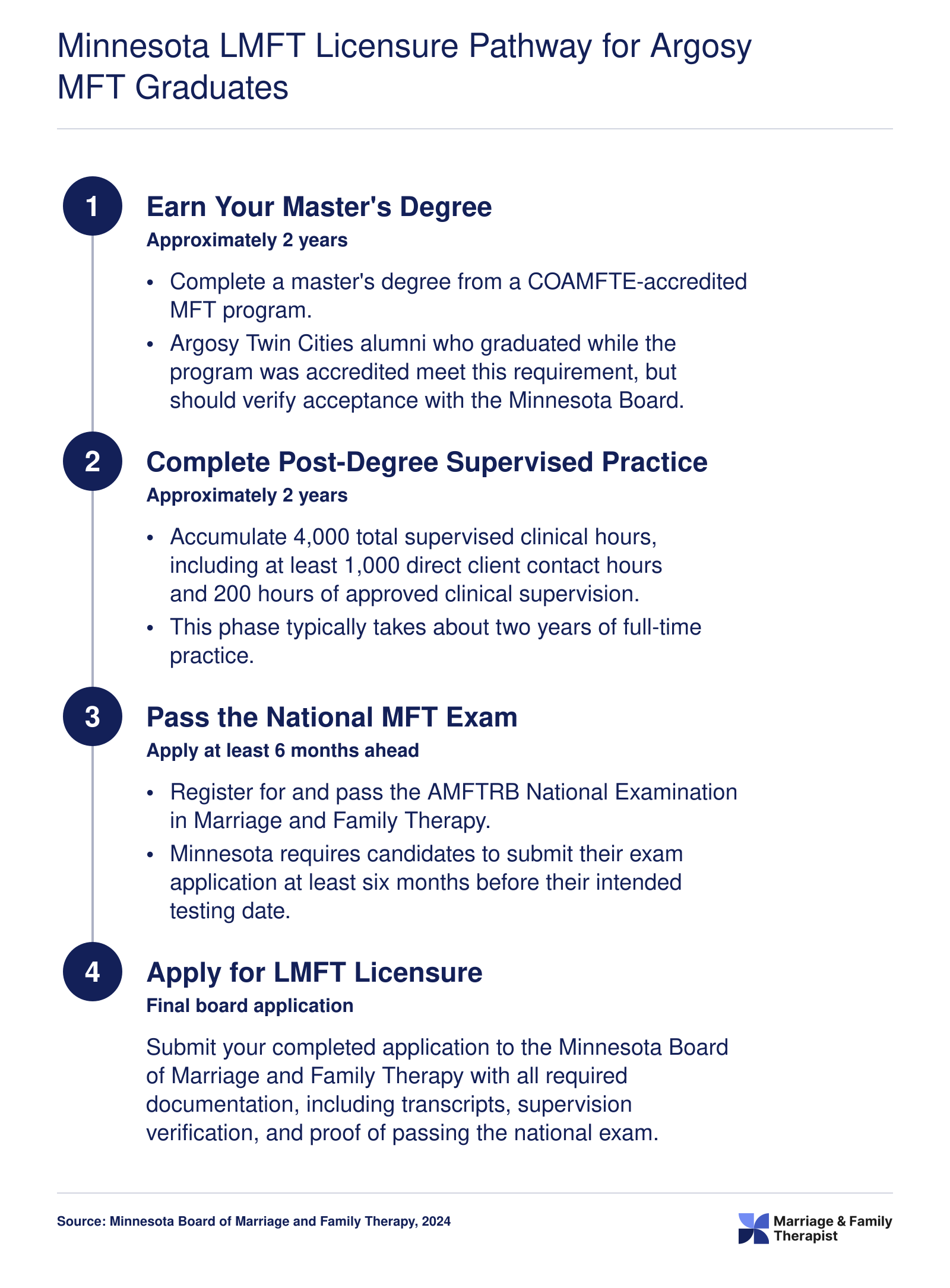
Minnesota LMFT Licensure Pathway for Argosy MFT Graduates
Argosy University Twin Cities graduates who completed their MFT degree while the program held COAMFTE accreditation generally satisfy the educational requirement for Minnesota LMFT licensure. However, because accreditation was later withdrawn, graduates should confirm current Minnesota Board of Marriage and Family Therapy policy on their specific situation before beginning the process. The typical timeline from enrollment to full licensure spans roughly four years.
Alternative Coamfte-Accredited MFT Programs in Minnesota
If you arrived at this page looking for the Argosy University Twin Cities MFT program, the most important next step is identifying a currently operating, COAMFTE-accredited alternative where you can earn a degree that meets Minnesota LMFT licensure requirements. As of the 2025-2026 academic year, the landscape of COAMFTE-accredited master's programs in Minnesota is notably limited, which makes your research both simpler and more high-stakes.
The Current COAMFTE-Accredited Option in Minnesota
According to the COAMFTE Directory of Accredited Programs, Saint Mary's University of Minnesota currently stands as the sole institution in the state offering a COAMFTE-accredited master's degree in Marriage and Family Therapy.1 Here is what prospective students should know:
Program: M.A. in Marriage and Family Therapy
Location: Minneapolis, MN (campus-based with some hybrid flexibility)
Credits required: 60
Estimated total cost: $42,000 to $48,000 (approximately $700 to $800 per credit)2
Institution type: Private nonprofit
Specialization areas: Child and adolescent therapy, couple therapy, diverse populations
Clinical training: Supervised clinical practice integrated into the curriculum
Licensure alignment: Designed to meet Minnesota LMFT licensure standards
Saint Mary's is a strong fit for students who want to stay in Minnesota, earn a COAMFTE-accredited degree, and complete their clinical training locally. Its specialization tracks in child and adolescent therapy and diverse populations offer meaningful differentiation for students who want clinical depth in those areas.
What About Other Minnesota Programs?
Institutions such as the University of Minnesota, Bethel University, and Adler Graduate School have historically offered MFT-related programs, but prospective students should verify each program's current COAMFTE accreditation status directly through the COAMFTE directory before applying.1 A program may prepare you for licensure without holding COAMFTE accreditation, and while that is not necessarily disqualifying, COAMFTE accreditation remains the gold standard for MFT education and is preferred or required by many state licensing boards and employers.
Choosing the Right Fit
With limited COAMFTE-accredited options in-state, your decision may come down to a few key questions:
Working professionals and career changers: Saint Mary's hybrid flexibility may help you balance coursework with existing commitments, though the program is primarily campus-based. Confirm the extent of hybrid scheduling directly with the admissions office.
Budget-conscious students: At an estimated total of $42,000 to $48,000, Saint Mary's falls in the moderate range for a private nonprofit. If cost is your primary concern, compare this against COAMFTE-accredited programs in neighboring states or those offering online delivery, which may carry different tuition structures.
Students open to relocating or studying online: Expanding your search beyond Minnesota significantly increases your options. Several COAMFTE-accredited online MFT programs in the Upper Midwest and nationally can still prepare you for Minnesota licensure, though you will need to verify that any out-of-state program meets Minnesota Board of Marriage and Family Therapy requirements.
The closure of Argosy University removed one of the few COAMFTE-accredited MFT programs in Minnesota, making Saint Mary's University the primary in-state pathway. If that program does not fit your needs, a broader regional or national search is your best next move. Our best online MFT programs comparison chart can help you filter currently accredited programs by format, cost, and location.
Frequently Asked Questions About the Argosy University Twin Cities MFT Program
The closure of Argosy University left many MFT students and alumni with urgent questions about their degrees, transcripts, and loan options. Below are direct answers to the most common questions, grounded in the latest available information as of 2026.
Is Argosy University Twin Cities still open?
No. Argosy University Twin Cities permanently closed in 2019 after its parent company, Education Management Corporation (later Dream Center Education Holdings), lost accreditation and faced financial collapse. The campus no longer operates, and no new students can enroll. Former students who need records or transcripts must go through designated custodians rather than the institution itself.
Is an Argosy University MFT degree still valid for LMFT licensure?
Yes. Degrees conferred before the closure remain valid. State licensing boards, including Minnesota's, generally accept completed degrees from institutions that held proper accreditation at the time of graduation. You may need to provide additional documentation, such as proof of COAMFTE accreditation status during your enrollment period, when applying for licensure.
Was the Argosy University Twin Cities MFT program COAMFTE accredited?
Yes. The MA in Marriage and Family Therapy at Argosy University Twin Cities held COAMFTE accreditation during its years of operation. This accreditation was recognized by state licensing boards and met the educational standards required for LMFT licensure in Minnesota and most other states. The accreditation ended when the institution closed.
How do Argosy University alumni get transcripts after the closure?
Argosy University student records were transferred to a designated custodian following the closure. Alumni should contact the custodian organization (information is available through the U.S. Department of Education's closed school resources) to request official transcripts. Processing times can vary, so plan ahead if you need transcripts for licensure applications, employment verification, or doctoral program admissions.
What are the best COAMFTE-accredited MFT programs in Minnesota right now?
As of 2026, Minnesota is home to several COAMFTE-accredited MFT programs. Options include programs at the University of Minnesota, Saint Mary's University of Minnesota, and Adler Graduate School, among others. Each varies in format, tuition, and clinical training model. marriagefamilytherapist.org maintains current profiles of COAMFTE-accredited programs to help you compare options side by side.
Is an MFT degree from a closed university worth anything?
A completed MFT degree from a program that was properly accredited at the time of graduation retains its academic and professional value. Licensing boards evaluate your credentials based on the accreditation status during your enrollment, not the institution's current operating status. That said, you should keep thorough records of your degree, transcripts, and accreditation documentation to streamline any future verification requests.
Can Argosy University students get their student loans discharged?
Federal student loan borrowers may qualify for closed school discharge if they were enrolled at the time of closure, were on an approved leave of absence, or withdrew within the qualifying window and did not complete a teach-out program. The typical discharge window is 120 days before closure, with an expanded window of 180 days in some cases. A receivership court settlement also secured roughly $2.1 million in relief for Argosy institutional loans specifically. Private loans are not covered by closed school discharge. Contact your federal loan servicer to check your eligibility.