Heard Partners with CAMFT: What It Means for California MFTs

How the new CAMFT–Heard collaboration gives California marriage and family therapists access to tailored financial services, from tax prep to student-loan planning.

By Emily CarterReviewed by Editorial & Advisory TeamUpdated June 10, 202620 min read
CAMFT & Heard Partnership: Financial Support for CA MFTs

What you’ll learn in this article…

  • Heard Partners and CAMFT launched a partnership on June 5, 2026, giving members discounted therapist-specific financial services.
  • CAMFT distributed $22,500 in scholarships and grants during 2025, with additional awards open for the 2025 to 2026 cycle.
  • Federal loan repayment programs like the NHSC offer eligible California LMFTs awards ranging from $50,000 to $100,000.
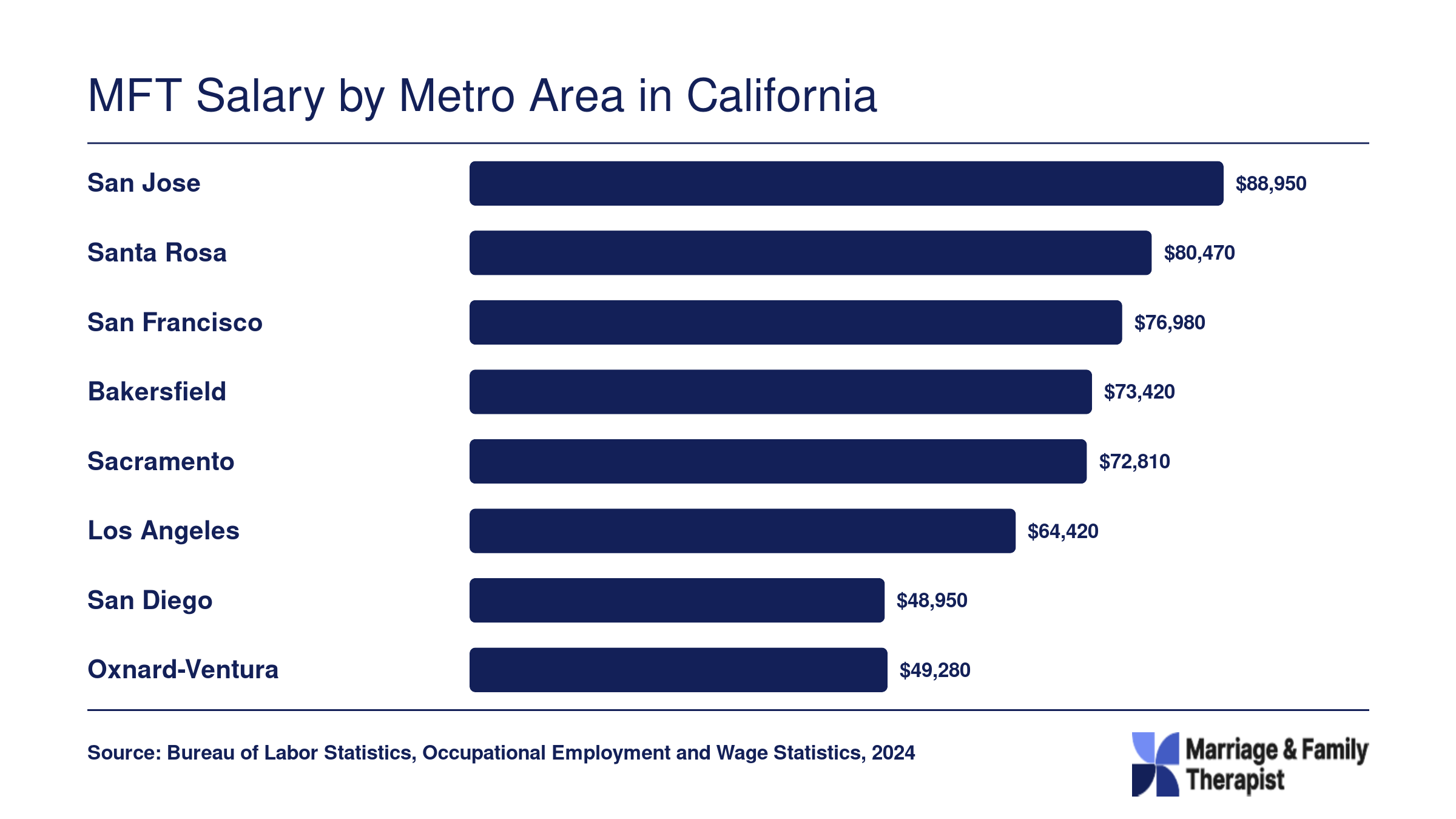
  • MFT median salaries vary by more than $40,000 across California metro areas, making location a major financial decision.

On June 5, 2026, Heard Partners and the California Association of Marriage and Family Therapists announced a partnership designed to deliver financial services built specifically for the workflows, tax structures, and variable income patterns of self-employed MFTs. The collaboration addresses a gap that most therapists in private practice know well: traditional accountants and financial planners rarely understand how to handle quarterly estimated taxes, mileage logs for home visits, deductions for telehealth technology, and the cash-flow volatility that comes with fee-for-service billing and insurance reimbursement cycles.

For more than 30,000 CAMFT members, the partnership unlocks an exclusive discount on Heard's accounting, bookkeeping, and tax-preparation platform, purpose-built for therapists rather than adapted from retail or corporate accounting. The announcement arrives as California MFTs face mounting financial pressures: student debt averaging $100,000 for doctoral graduates, rising malpractice premiums, and the administrative burden of managing a small business without a back-office team. For clinicians still exploring how to become a licensed marriage and family therapist, understanding these financial realities early can shape smarter career planning. Therapist-specific financial planning has historically been scarce, forcing many clinicians to cobble together generic software and hourly advisors unfamiliar with the profession.

What the Heard–CAMFT Partnership Offers California MFTs

What exactly does the Heard, CAMFT partnership offer, and how can California MFTs take advantage of the exclusive member discount?

Announced on June 5, 2026, the collaboration between the California Association of Marriage and Family Therapists (CAMFT) and Heard Partners delivers therapist-specific financial services to the state's largest professional community of MFTs.1 The partnership gives CAMFT members a direct path to tax preparation, bookkeeping, and unlimited expert support built around the realities of private practice.2

What's Included in the Partnership

The core offering bundles three services into one annual plan:

  • Bookkeeping: Ongoing transaction categorization, expense tracking, and financial organization tailored for solo and group therapy practices.
  • Tax preparation: Year-round tax planning and filing that accounts for self-employment income, estimated quarterly payments, and practice-specific deductions.
  • Unlimited expert support: Direct access to financial professionals familiar with MFT licensure fees, continuing education costs, and the intricacies of Schedule C filings.

While Heard often provides student loan planning and retirement guidance, those are not formally part of this CAMFT-specific package.2 Members can still discuss their broader goals during consultations, but the discounted bundle focuses on the back-office financial tasks that most frequently consume a therapist's time.

How the CAMFT Member Discount Works

The exclusive 15% discount applies to annual Heard plans, and members can also access a 50% reduction on catch-up bookkeeping when organizing 2026 records.2 This means a therapist who has let receipts pile up can get their books current at half the standard rate, making the spring tax season far less stressful. The pricing tier is reserved solely for CAMFT members; non-members who approach Heard independently do not receive these negotiated rates.

How to Enroll as a CAMFT Member

Eligibility covers all active CAMFT members, whether they hold full LMFT licensure or are pre-licensed associates building hours. For those still weighing the difference between AMFT and LMFT, both credential levels qualify. The enrollment process is straightforward:

  • Schedule a free consultation through the Heard or CAMFT partner page.1
  • Identify yourself as a CAMFT member during signup.
  • Choose the annual plan that fits your practice volume; the discount is automatically applied.

There is no additional fee to activate the partnership benefits beyond maintaining a current CAMFT membership.

Why Therapist-Specific Financial Support Matters

Generic accountants often overlook the expenses that define a marriage and family therapy practice. Self-employment tax nuances, office rent or in-home office deductions, supervision costs, malpractice insurance premiums, and CEU travel are all legitimate write-offs that generalist preparers may miss. Therapists already evaluating whether their MFT degree is worth it financially should factor in how much money proper tax strategy can recover each year. Heard's model incorporates these deductions as standard practice, and the CAMFT partnership puts that expertise within reach at a reduced rate.3 For therapists juggling client care, note-taking, and licensure requirements, outsourcing the numbers to professionals who understand the field can translate into more time spent on clinical work and less on administrative headaches.

Who Is Heard Partners and Why Therapists Use Them

Heard is not a generic accounting firm that happens to take on a few therapy clients. Founded in 2019, the venture-backed company was purpose-built to handle the financial workflows that therapists in private practice deal with every month.1 Since its launch, Heard has grown to serve thousands of therapists across the country, offering monthly subscription tiers that bundle core financial services into a single platform.

Core Services Heard Provides

Hearing the word "bookkeeper" might conjure images of a local CPA hunched over spreadsheets, but Heard's model is fundamentally different. The platform packages several services therapists typically cobble together from multiple providers:

  • Bookkeeping: Automated categorization and reconciliation of practice income and expenses, updated on an ongoing basis rather than once a year.
  • Tax preparation and filing: Handled by professionals who understand therapy-specific deductions, from telehealth software subscriptions to continuing education costs.
  • Payroll: For group practice owners who need to pay associates or administrative staff without juggling a separate payroll vendor.
  • Financial dashboards: Real-time reporting that shows revenue trends, profit margins, and cash flow so clinicians can make informed decisions about caseload and pricing.
  • Student loan optimization: Guidance on repayment strategies, including income-driven plans and Public Service Loan Forgiveness eligibility, tailored to a therapist's income trajectory.

Each tier also includes access to human support, meaning subscribers can ask questions of real financial professionals rather than relying solely on automated tools.

How Heard Differs from a Local CPA

A traditional accountant may be perfectly competent but rarely specializes in the revenue patterns therapists face. Private practice income fluctuates with client cancellations, insurance reimbursement delays, and seasonal dips in caseload. Heard's platform is designed to track that variable revenue automatically, flagging anomalies and adjusting quarterly tax estimates accordingly.

The company also integrates with the practice management and electronic health record tools many therapists already use. That connectivity reduces manual data entry and the risk of errors that crop up when financial records live in one system while clinical records live in another. For those still weighing whether the investment in a therapy career pencils out, our guide on how to afford an MFT degree covers scholarships and financial aid options that can ease the burden before you even enter practice.

A Growing Presence in the Therapy Community

The CAMFT partnership is Heard's most prominent professional association collaboration to date.1 By aligning with the largest organization representing California's marriage and family therapists, Heard positions itself as a go-to resource for clinicians who want financial management that actually reflects the realities of therapeutic practice. For MFTs weighing whether to invest in dedicated financial support, the platform's specialization is its strongest selling point: every feature, template, and advisor interaction is calibrated to the way therapists earn, spend, and plan.

CAMFT Scholarships, Grants, and Member Discounts

Beyond the Heard partnership, CAMFT administers a suite of direct financial aid programs that collectively distributed $22,500 in 2025 across five scholarships and one grant.1 For the 2025, 2026 cycle, the association again offers four named scholarships plus two newer awards, each targeting different career stages and funding priorities.

Scholarships for Students and Pre-Licensed MFTs

The CAMFT Educational Foundation Scholarship awards $4,000 to pre-licensed MFT students engaged in advanced training or unpaid internships.2 Eligibility hinges on demonstrated financial need and a clear professional commitment to marriage and family therapy, making it a strong fit for those nearing the associate licensure phase but still without paid clinical hours.

The Clinton E. Phillips Scholarship, also $4,000, requires enrollment in an approved MFT degree program or an advanced degree in the field.2 Selection criteria emphasize good academic standing, high achievement, financial need, and community or civic involvement. This scholarship rewards students who balance academic excellence with service outside the classroom.

The Ronald D. Lunsford Scholarship mirrors the Phillips award in dollar amount ($4,000) and criteria (good standing, high achievement, need, involvement) but reserves eligibility for members of ethnic or racial minority groups pursuing approved MFT degrees or advanced degrees.2 Named after a CAMFT leader who championed diversity, the scholarship explicitly works to broaden the profession's demographic base.

Two additional $4,000 scholarships launched in the 2025 cycle bring the student-focused total to five awards.1 CAMFT has not yet published the formal names or detailed criteria for these newer scholarships, but their inclusion underscores a commitment to expanding aid as MFT enrollment rebounds post-pandemic. Students exploring additional funding options should also review MFT scholarships and financial aid beyond what CAMFT offers directly.

The Grant for Licensed and Pre-Licensed Professionals

The CAMFT Educational Foundation Grant awards $2,500 to licensed or pre-licensed MFTs for projects or activities that benefit the broader profession.2 Eligible uses include specialized training, collaborative community events, and research initiatives that advance marriage and family therapy practice or public understanding. The 2026 application deadline falls on November 7, offering a clear timeline for planners launching workshops, symposia, or pilot studies.3

Member Discounts and How to Apply

All scholarships and the grant require current CAMFT membership, which starts at a student rate and scales with licensure status. Applications typically open in late spring, and CAMFT's Educational Foundation page and instructional video provide year-round details on submission requirements, selection timelines, and past recipient profiles.2 Because award counts remain modest relative to California's MFT student population, competitive applications pair strong narratives of professional purpose with documented financial need and tangible contributions to the field or community. Applicants considering cheapest MFT programs can further reduce their overall educational costs while strengthening their case for financial need.

Additional Financial Support Programs for California MFTs

Award amounts up to $50,000 to $100,000 are available through the National Health Service Corps (NHSC) Loan Repayment Program for eligible mental health professionals, including LMFTs who commit to serving in designated Health Professional Shortage Areas. Beyond the Heard-CAMFT partnership, California marriage and family therapists have access to a suite of state, federal, and institutional financial support programs that can significantly reduce educational debt and offset the costs of training. These programs range from scholarship stipends that support students during their graduate training to loan repayment initiatives for practicing clinicians. Understanding the landscape of available aid, application timelines, and service commitments is essential for MFTs at every career stage.

National Health Service Corps (NHSC) Loan Repayment Program

The NHSC Loan Repayment Program targets clinicians working in underserved communities and has expanded eligibility to include licensed marriage and family therapists in recent years. LMFTs who practice in NHSC-approved sites, such as Federally Qualified Health Centers or community mental health clinics in Health Professional Shortage Areas, can apply for awards ranging from $50,000 to $100,000 in exchange for a two- or three-year service commitment. Application windows typically open each spring, and the program prioritizes clinicians in areas with the greatest need. Applicants should check the NHSC website at nhsc.hrsa.gov regularly for updates on eligibility criteria, approved service sites, and current funding availability, as details can shift annually based on federal appropriations.

California Mental Health Stipend Programs

California offers several stipend programs designed to support graduate students in mental health fields. The California Behavioral Health Scholarship Program provides awards of $25,000 to students pursuing degrees in psychiatry, psychology, clinical social work, or marriage and family therapy.1 Recipients commit to working in an underserved area or with an underserved population for a specified period after graduation, and applications are due each February.1 Additionally, CalSWEC, administered through the University of California, Berkeley, historically managed stipend programs for social work students and has expanded partnerships to include other mental health disciplines at select campuses. Students should visit the CalSWEC website at calswec.berkeley.edu and contact their university's MFT program directly to inquire about current mental health stipend offerings, which have ranged from $18,500 to $25,000 annually, and to confirm application deadlines and service requirements.

County and Federal Workforce Development Grants

Many California counties operate their own stipend and loan forgiveness programs to recruit mental health clinicians. Los Angeles County Department of Mental Health, for example, has offered training stipends and loan repayment assistance to clinicians who commit to serving county clients. Prospective applicants should explore individual county mental health department websites for eligibility details and application cycles. At the federal level, the Health Resources and Services Administration (HRSA) administers the Behavioral Health Workforce Education and Training (BHWET) grants, which fund universities and training programs to expand the mental health workforce. While BHWET funds typically flow to institutions rather than individuals, students enrolled in BHWET-supported programs may receive tuition support or stipends. Check the HRSA BHWET page at bhw.hrsa.gov for a list of current grant recipients and MFT-specific training initiatives.

Professional Association and Institutional Scholarships

In addition to government programs, California MFT students can access scholarships from professional associations and healthcare organizations. The CAMFT Educational Foundation Scholarships and Grant awarded up to $4,000 in the 2025-2026 cycle, with applications due in early November.2 Kaiser Permanente's Mental Health Scholars Academy offered a $3,000 scholarship for the 2026 cycle, with a March 3, 2026 deadline.1 HealthForce Partners provides scholarships of $5,000 to MSW, MFT, and PCC students, and the National Board for Certified Counselors (NBCC) offers Rural and Military Graduate Scholarships of $8,000 to students committed to serving military and veteran families.1 University-specific aid is also available. San Francisco State University and UCLA both maintain dedicated pages listing state grants and institutional scholarships for graduate students in mental health fields, accessible through their financial aid offices.

Public Service Loan Forgiveness for MFTs

Marriage and family therapists employed full-time by qualifying nonprofit or government agencies may be eligible for Public Service Loan Forgiveness (PSLF), which forgives the remaining balance on federal Direct Loans after 120 qualifying monthly payments under an income-driven repayment plan. Clinicians pursuing California LMFT licensing who work in community mental health centers, public schools, or nonprofit hospitals should confirm their employer's PSLF eligibility and enroll in an income-driven repayment plan as early as possible. PSLF does not require upfront application fees or service in a specific geographic area, making it a versatile option for MFTs in diverse practice settings.


Questions to Ask Yourself

You may already qualify for federal loan repayment without realizing it. HPSA-designated sites unlock programs like the National Health Service Corps (NHSC) Loan Repayment Program, which awards up to $50,000 tax-free for two years of service, and many therapists in rural or underserved California counties meet the criteria.

Public Service Loan Forgiveness (PSLF) forgives remaining balances after 120 qualifying payments at a nonprofit employer, but if your loans are small or your income high, an accelerated repayment plan may cost you less in total interest. Run the numbers with your actual figures before committing to a decade-long strategy.

Some county stipend programs and employer-sponsored loan assistance are only open during the associate/trainee phase, not after licensure. Check application deadlines now, especially if you are completing your supervised hours in a public mental health setting or community clinic.

Financial Challenges Unique to MFTs in Private Practice

A salaried MFT at a community mental health center and a solo practitioner running a private practice may hold the same license, but their financial realities could not be more different. The employed therapist receives a predictable paycheck, employer-matched retirement contributions, and a W-2 at tax time. The private practitioner faces a layered set of financial pressures that catch many new LMFTs off guard.

The Self-Employment Tax Reality

When you run your own practice, there is no employer absorbing half of your payroll taxes. Self-employed therapists pay both the employer and employee portions of FICA, which adds up to roughly 15.3 percent on net earnings. That figure can come as a shock after years of seeing only the employee side on a pay stub. Setting aside a portion of every payment received, rather than waiting until April, is the only reliable way to stay ahead of this obligation.

Variable Income and No-Shows

Private practice income is not a salary. Caseloads shrink in summer and around major holidays, and a single no-show session represents direct, unrecoverable revenue loss. Unlike an agency role where a missed appointment is an administrative inconvenience, in private practice it is a line item that simply disappears. Building a cash reserve equal to two or three months of operating expenses is a commonly recommended buffer, though few training programs discuss it. Understanding the full range of marriage and family therapist salary expectations can help practitioners set realistic revenue targets from the start.

Deductions Many MFTs Overlook

The tax code does offer real relief to self-employed therapists, but only if they claim it. Many MFTs leave money on the table by missing legitimate deductions:

  • Supervision fees: Costs paid for clinical supervision are deductible business expenses.
  • Continuing education: Licensing renewal courses, workshops, and conference registrations qualify.
  • Malpractice insurance: Professional liability premiums are fully deductible.
  • Office lease and EHR software: Rent, telehealth platforms, and practice management tools all count.
  • CAMFT membership dues: Professional association fees paid to maintain standing are deductible.

The Hidden Cost of Pre-Licensure

Associate MFTs working toward their supervised hours often pay out of pocket for that supervision, sometimes hundreds of dollars per month, while earning wages well below what a licensed clinician commands. There is no guaranteed income increase at the end of that period and no employer subsidy for the cost of hours required by the state. For many trainees, the financial demands during MFT clinical internship hours represent one of the least-discussed strains in the profession.

Retirement Without an Employer Plan

Without a workplace 401(k), retirement planning falls entirely on the individual therapist. The two most practical options for self-employed MFTs are a SEP-IRA, which allows contributions of up to 25 percent of net self-employment income, and a Solo 401(k), which can accommodate higher total contributions for therapists with steady earnings. Both accounts reduce taxable income in the year contributions are made, making them tools for both retirement security and current-year tax management. Starting either account early in private practice, even with modest contributions, compounds significantly over a career.

MFT Salary by Metro Area in California

Where you practice in California can significantly affect your earning potential as a marriage and family therapist. The gap between the highest-paying and lowest-paying metro areas exceeds $40,000 at the median level, making location one of the most important financial decisions for MFTs planning their careers.

MFT Salary by Metro Area in California

Starting in January 2024, licensed marriage and family therapists in California gained the right to bill Medicare directly for the first time. Under the updated CMS fee schedule, LMFTs are reimbursed at 75 percent of the standard physician rate, meaning a 60-minute individual session (CPT code 90837) now generates a direct Medicare payment for California MFTs.

Step-by-Step: How to Access Financial Support as a California MFT

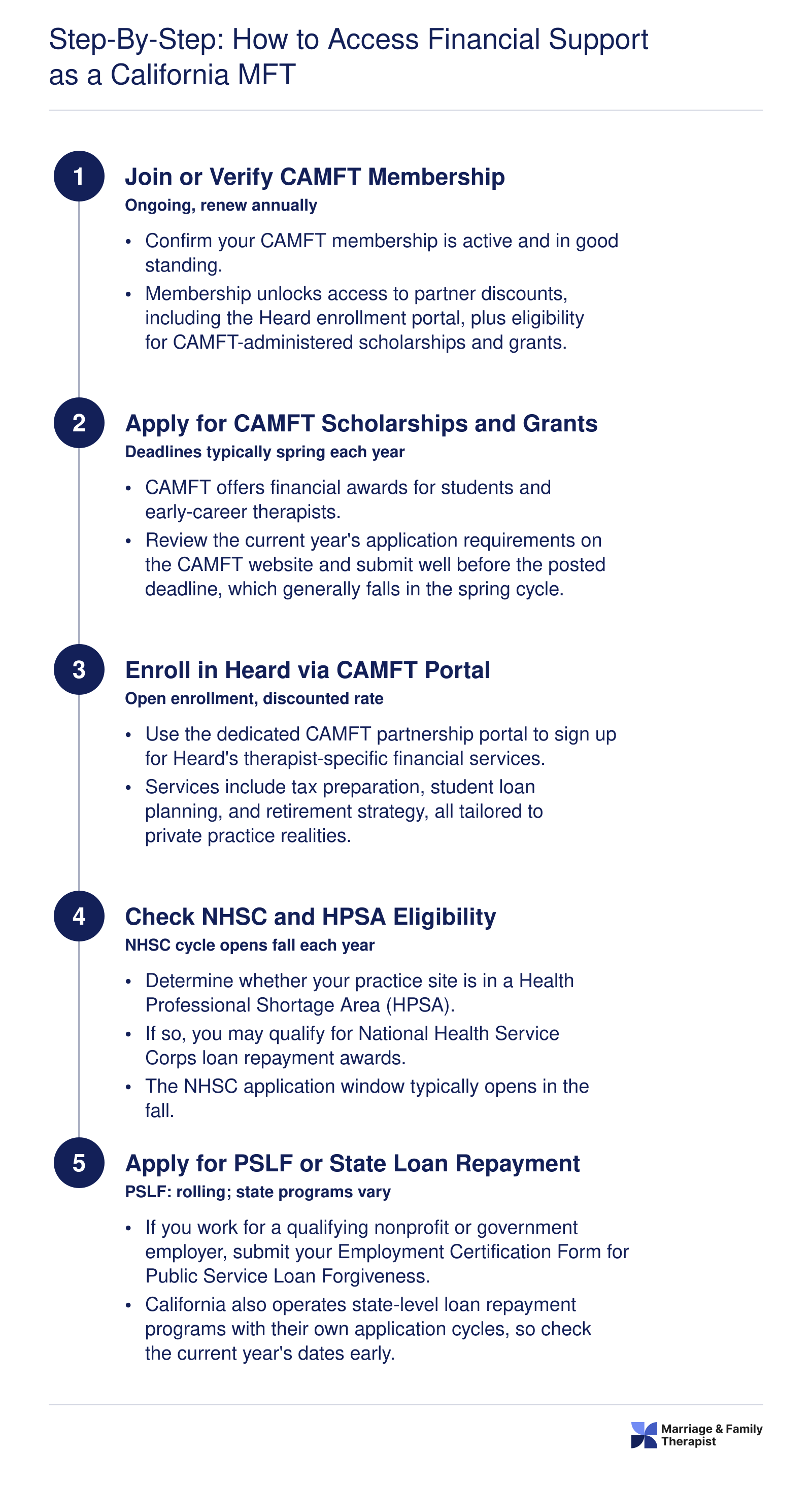
California MFTs have several financial support channels available, but each operates on its own timeline and application cycle. Following a structured sequence helps you avoid missed deadlines and maximize every benefit you qualify for.

Five-step process for California MFTs to access financial support, from CAMFT membership through loan repayment applications

Frequently Asked Questions

Below are answers to some of the most common questions California MFTs and aspiring therapists ask about earnings, financial support, and the Heard and CAMFT partnership. Where specific figures are available, we have included them to help you plan.

How much does the average MFT make in California?
According to the U.S. Bureau of Labor Statistics, marriage and family therapists in California earn a mean annual wage that ranks among the highest in the nation, typically ranging from roughly $60,000 to over $90,000 depending on metro area, experience, and practice setting. Therapists in private practice may earn more but also face higher overhead costs.
What does Medicare pay MFTs in California?
As of 2024, Medicare began covering services provided by licensed marriage and family therapists under new federal provisions. Reimbursement rates vary by service code and geographic region but generally align with rates paid to licensed clinical social workers. California MFTs should verify current fee schedules through the Centers for Medicare and Medicaid Services.
What scholarships and grants does CAMFT offer for MFTs?
CAMFT, the California Association of Marriage and Family Therapists, periodically offers educational scholarships and grants to student members and early career professionals. Award amounts and eligibility criteria vary each cycle. CAMFT members should check the organization's website for the latest funding opportunities, application deadlines, and requirements.
What loan repayment programs are available for MFTs in California?
California MFTs may qualify for federal programs such as the National Health Service Corps Loan Repayment Program if they work in underserved areas. The state also offers loan repayment assistance through programs targeting mental health professionals in high need communities. Eligibility typically requires working at an approved site for a set service commitment period.
What is included in the CAMFT and Heard partnership for California therapists?
Through this collaboration, CAMFT members gain access to Heard Partners' therapist specific financial services, including student loan planning, tax preparation, bookkeeping, and retirement planning. The partnership is designed to reduce administrative burdens so California MFTs can focus on clinical work rather than navigating complex financial tasks on their own.
Is there financial assistance available for MFT students or pre-licensed associates?
Yes. MFT students and pre-licensed associates can explore CAMFT scholarships, federal student aid, and state workforce development grants. Some training sites also offer stipends. Additionally, the National Health Service Corps offers loan repayment to clinicians, including associates, who commit to serving in designated shortage areas after licensure.
Can pre-licensed MFT associates use Heard's services?
Heard Partners primarily serves licensed therapists and those operating private practices. Pre-licensed associates should confirm current eligibility directly with Heard, as service availability may expand over time. Even before full licensure, associates can benefit from Heard's educational resources on tax planning and financial management to prepare for independent practice.

Recent Articles