The University of Arizona's graduate financial therapy certificate is fully online and completed in two semesters.
The curriculum covers money psychology, couples finance, behavioral decisions, and current research trends.
MFTs can use the certificate to address financial stress, a leading cause of relationship conflict.
The program's August 1, 2026 deadline makes immediate action necessary for fall enrollment.
Money conflicts are the most common source of stress in relationships, yet marriage and family therapy graduate programs rarely cover financial psychology. Starting fall 2026, the University of Arizona's Norton School of Human Ecology will address that gap with a fully online, two-semester graduate certificate in financial therapy, the first program of its kind in the western United States.
Designed for working clinicians, the certificate integrates directly with existing MFT skills and is taught in part by a licensed marriage and family therapist. As financial stress reshapes the therapy landscape, this credential gives MFTs a structured way to build the financial counseling skills clients are seeking.
What Is the University of Arizona Financial Therapy Certificate?
A Hybrid Discipline Gains a Dedicated Program
The convergence of financial planning and mental health care has been building for years, but formal training pathways remained scarce. The University of Arizona now fills that gap with a graduate certificate that equips professionals to address the full spectrum of money-related stress. Financial therapy, as a practice, explores the cognitive, emotional, behavioral, and relational dimensions of financial well-being, issues that surface frequently in both therapy offices and financial advisory meetings.
Program Structure and Who It Serves
Launched in fall 2026, the Financial Therapy Certificate resides in the Norton School of Human Ecology under the direction of Kenneth White. It is a 12-credit, 100% online program that can be finished in two semesters.1 The curriculum targets a dual audience: mental health clinicians, including marriage and family therapists, and financial services professionals.2 No prior coursework in finance or therapy is required beyond a bachelor's degree, though applicants should hold a professional license or have relevant experience in their field. Tuition for the full certificate is $34,100,3 positioning it as an investment in a niche specialization.
Clinical Credibility for MFTs
What sets this certificate apart for MFTs is its direct connection to clinical practice. Among the faculty is Jessica Nelson, a licensed marriage and family therapist and adjunct professor in the Personal and Family Financial Planning Program. Her involvement ensures that course material is not merely academic but applicable to the therapy room. Courses such as "Love & Money" and "Decisions, Behavior, and Finances" directly address the relational and psychological patterns that couples and families bring into sessions. MFTs considering the credential can also review how to become an LMFT in Arizona for context on how a graduate certificate fits within state licensure requirements.
Accessibility and Geographic Significance
Touted as the first program of its kind in the western United States, this certificate removes common barriers. There are no campus visits, no relocation requirements, and no scheduling conflicts with a full-time practice. The online, asynchronous format allows professionals to earn the credential while continuing to see clients. With an application deadline of August 1 for fall admission,4 prospective students can plan their enrollment without lengthy lead times. The program's design reflects a deliberate effort to make financial therapy education more widely available to working clinicians across the region.
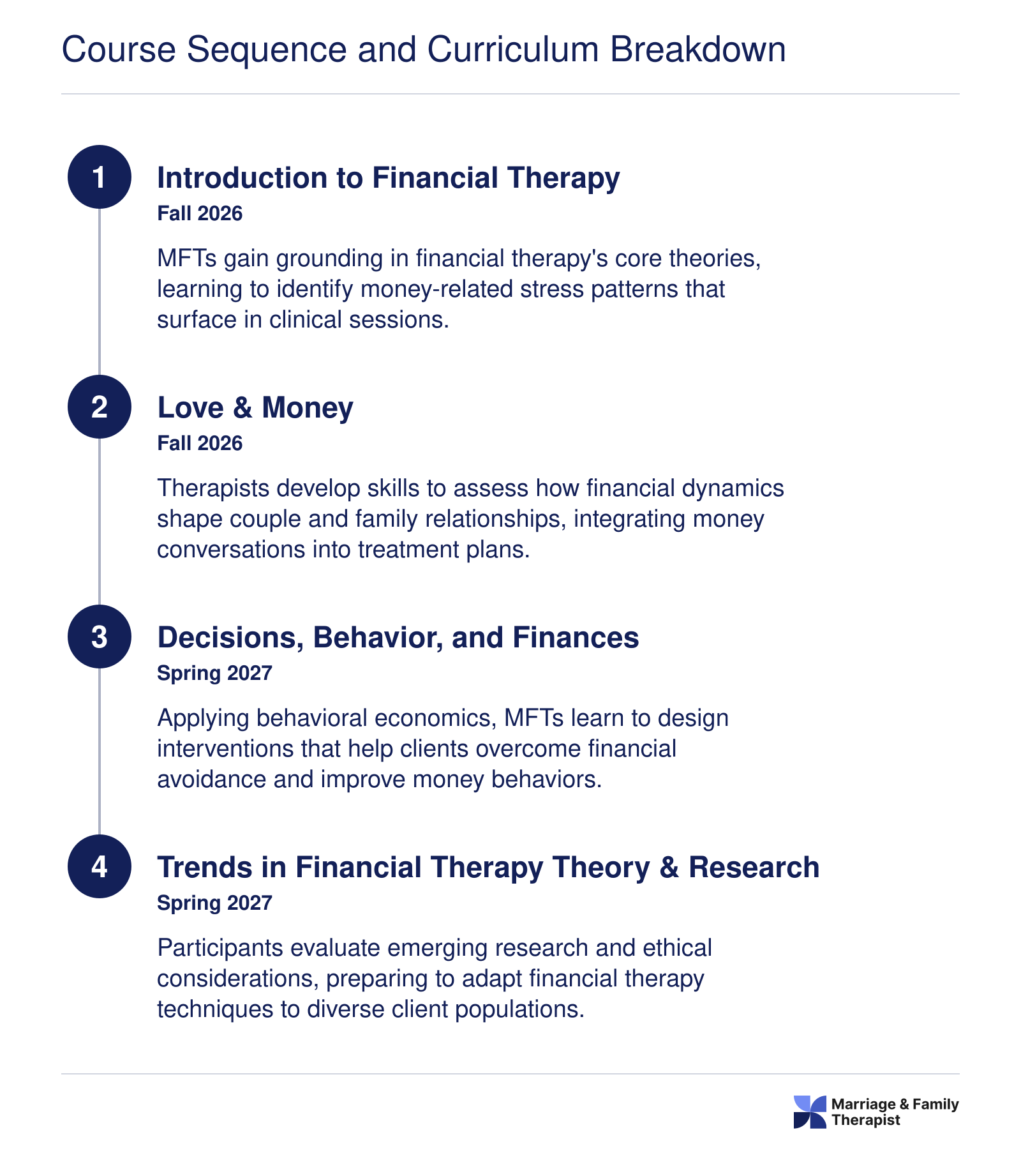
Course Sequence and Curriculum Breakdown
The University of Arizona's new financial therapy certificate is structured as a four-course, two-semester online program. Each course builds on the last, equipping marriage and family therapists with practical skills from foundational theory to applied research.
Why Financial Therapy Matters for Marriage and Family Therapists
Most MFT graduate programs equip you to address attachment injuries, communication breakdowns, and trauma histories , but they often skip the topic that brings couples through the door: money. Financial stress consistently ranks as a top predictor of divorce and a primary source of conflict in families. Yet many therapists graduate without a structured way to explore a client's relationship with earning, spending, debt, or inherited money beliefs. The University of Arizona's new certificate fills that gap by building a bridge between clinical expertise and financial psychology.
Money as a Core Relational Issue
In couples therapy, arguments about finances are rarely about dollar amounts alone. They surface deeper dynamics around power, trust, security, and self-worth. Without specific training, even seasoned MFTs can struggle to differentiate a values-based disagreement from a symptom of financial anxiety or a pattern of financial abuse. Financial therapy certification gives you tools to identify when money behaviors are rooted in family-of-origin scripts, shame, or trauma, and how to address those patterns therapeutically rather than simply suggesting a budgeting app.
Clinical Skills That Go Beyond Budgeting
Financial therapy training equips you to handle several clinical scenarios that standard MFT education often overlooks. You learn to assess for financial abuse in intimate partner violence cases, where economic control is a powerful coercive tactic. You develop frameworks for navigating intergenerational money beliefs that drive conflict between spouses or across generations in family systems therapy specialization. The program also addresses treating financial disorders such as compulsive spending or pathological gambling, which frequently co-occur with mood and anxiety disorders. These skills let you treat the whole relational system instead of referring out a core piece of the client's distress.
A Certificate Designed by Therapists, for Therapists
The presence of a licensed marriage and family therapist, Jessica Nelson, on the program's faculty signals that this certificate was built with clinical practitioners in mind, not just financial planners. The coursework integrates therapeutic techniques with financial concepts, so you are not learning to sell insurance or manage portfolios. Instead, you are deepening your ability to hold space for money-related emotions, challenge irrational beliefs about wealth, and help couples develop shared financial meaning. This is not a pivot into a new career; it is a specialization that enhances the work you already do.
Questions to Ask Yourself
Do your clients ever argue about money, and do you feel equipped to guide those conversations beyond surface-level conflict resolution?
Money conflict often masks deeper issues like financial trauma or mismatched values. Without training, you may only scratch the surface.
Have you considered how adding a financial therapy specialty could differentiate your practice in a competitive market?
Adding financial therapy can set you apart in a crowded therapy market, appealing to clients who want help with both emotional and financial challenges.
Would a fully online, two-semester program fit into your schedule alongside clinical work?
This online, self-paced program fits around clinical hours, letting you earn a career-boosting credential without stepping away from your current caseload.
Admissions, Tuition, and How to Apply
The certificate's two-semester online format balances speed and accessibility, but prospects must weigh the upfront cost against the longer-term practice expansion it enables. As of 2026, specific credit hours and per-credit tuition have not been finalized publicly. Early indicators suggest a total around 12 graduate credits, with online students often paying a flat rate regardless of residency. Contact the Norton School directly for current figures; financial aid eligibility may extend to certificate-seeking students through federal loan programs.
Who Can Apply
A completed bachelor's degree from an accredited institution is the minimum entry requirement. The program actively invites both licensed therapists and financial professionals, meaning you do not need a master's in counseling to be considered. Selection emphasizes professional relevance: admissions reviewers look for work in therapeutic, behavioral health, or financial services roles, and a statement of purpose that connects the certificate to your career goals. If you want a broader look at financial therapy certification pathways before applying, that context can help sharpen your personal statement.
Application Timeline and Steps
Deadline: August 1 for the fall 2026 cohort.
Portal: Submit through the University of Arizona Graduate College application system.
Materials: Official transcripts, a current resume, a personal statement, and typically two professional references. No GRE or entrance exam is required.
Background Considerations
There are no rigid prerequisites, but the curriculum assumes foundational knowledge in either human behavior or personal finance. If you come from a strictly financial planning background, the introductory course and the "Love & Money" module are structured to bring you up to speed on therapeutic frameworks, while therapists will deepen their financial psychology lens through the spring coursework. Faculty advisors can guide supplemental reading if needed.
Financial Therapy Certificate Vs. CFT™ Credential: What's the Difference?
An academic certificate and a professional certification offer two distinct paths to expertise in financial therapy. The University of Arizona's graduate program delivers focused, credit-bearing coursework, while the Financial Therapy Association's CFT™ credential represents a broader, practice-based validation of competence. Understanding how they differ, and how they might complement each other, helps marriage and family therapists choose the right investment for their career.
Understanding the CFT™ Credential
The Certified Financial Therapist (CFT™) credential, issued by the Financial Therapy Association (FTA), is a professional designation for practitioners who integrate therapeutic and financial competencies.1 It requires a master's degree or higher in a qualifying field such as psychology, counseling, or financial planning, along with specific graduate-level coursework in financial therapy. Candidates must complete a set number of supervised client-contact hours and pass a comprehensive exam. Once earned, the credential is maintained through continuing education units and periodic renewal, ensuring practitioners stay current with evolving research and ethical standards.
Does the UA Certificate Count Toward CFT™?
The University of Arizona's graduate certificate provides a structured academic foundation in financial therapy through its four-course sequence.2 While the program's curriculum aligns with many topics tested by the CFT™, including money psychology, couple dynamics, and behavioral finance, it does not automatically fulfill the FTA's educational prerequisites. Prospective CFT™ candidates should contact the Financial Therapy Association directly to determine if specific certificate courses meet the coursework or elective requirements. However, the certificate offers a practical head start: for an MFT already in clinical practice, it supplies the language and frameworks needed to begin integrating financial discussions into therapy sessions, potentially accelerating the supervised experience component. MFTs interested in financial therapy certification should review both pathways before committing resources.
Choosing the Right Path for Your Career
Clinical specialization add-on: The UA certificate is ideal for licensed MFTs who want to address money-related stress in couples and families without pursuing a separate certification. It is quick, online, and directly applicable to daily practice.
Professional designation: The CFT™ credential signals a deeper, standardized expertise that may open doors to specialized roles, consulting, or higher billing rates. It requires a longer commitment and ongoing recertification but carries national recognition.
Stackable credentials: Some therapists may earn the certificate first, apply the learning immediately, and later pursue the CFT™ if their professional goals evolve.
Both pathways strengthen an MFT's ability to help clients navigate the emotional dimensions of money, a critical and often overlooked skill in therapeutic work.
Career Outlook and Salary Context for Financial Therapists
Financial therapy is not yet recognized as a standalone occupation by the Bureau of Labor Statistics, so official wage data specifically for financial therapists is unavailable. The figures below reflect current BLS data for Marriage and Family Therapists, which establishes a baseline earning potential that a financial therapy specialization can enhance. Adding a financial therapy credential can command premium rates in private practice, open hybrid roles in financial planning or employee assistance programs, and position you at the intersection of mental health and financial wellness.
Metric
Value
Median annual wage for MFTs in Arizona
$52,420
25th percentile wage for MFTs in Arizona
$48,860
75th percentile wage for MFTs in Arizona
$57,570
Projected U.S. job growth for MFTs (2024 - 2034)
13%
Average annual job openings for MFTs (2024 - 2034)
7,700
Financial therapy is one of the fastest-growing specialization areas for marriage and family therapists, and the University of Arizona certificate provides a structured, low-commitment entry point. The program is fully online, completed in two semesters, and backed by a recognized R1 research institution, making it an accessible way to build in-demand skills for addressing money-related stress in clinical work.
How This Certificate Compares to Other Financial Therapy Programs
What sets the University of Arizona's financial therapy certificate apart from other graduate programs in the field?
What Other Financial Therapy Programs Exist?
The financial therapy discipline is still young, but a few universities have developed graduate certificates or concentration areas that blend personal finance with therapeutic skill sets. The University of Arizona's offering distinguishes itself as the first of its kind in the western United States and is designed from the ground up with working marriage and family therapists in mind. Other institutions may house related coursework within broader financial planning or behavioral economics departments, but their structure, credit requirements, and online availability can differ markedly.
Because program offerings evolve and new certificates emerge regularly, the most reliable way to survey the landscape is through professional organizations. The Financial Therapy Association maintains a directory of academic programs that can serve as a starting point. From there, contacting individual universities such as the University of Georgia or Kansas State University directly will give you the most accurate picture of what they currently provide.
Why You Should Verify Program Details Firsthand
Tuition rates, credit hours, and delivery formats are not static. A program that was campus-only last year may now offer a fully online option; a four-course sequence might be restructured into two longer seminars. Published web pages sometimes lag behind these changes, which is why relying solely on aggregated or secondhand information can lead to outdated impressions.
Connecting with an admissions counselor or program coordinator puts you in touch with the latest catalog details, upcoming course schedules, and any hidden prerequisites that might affect your enrollment timeline. This is especially relevant if you hold an LMFT and want to confirm that the curriculum complements your existing clinical knowledge rather than duplicating it. If tuition is a concern, reviewing MFT scholarships and financial aid options before you enroll can make the investment more manageable.
How to Research Financial Therapy Programs Effectively
Start with authoritative directories: The Financial Therapy Association's website and the U.S. Bureau of Labor Statistics can point you toward recognized credentials and educational pathways.
Review official course catalogs: University websites typically publish current tuition per credit, total credit requirements, and course descriptions that clarify the program's focus: is it grounded in clinical intervention, financial planning, or both?
Ask about format and flexibility: Look for whether courses are asynchronous, synchronous, or hybrid, and if any in-person components or clinical placements are required. The Arizona certificate is 100% online and built for two semesters, a structure that may or may not be matched elsewhere.
Contact program directors: A brief phone call or email can answer questions about class size, faculty background, and how the certificate aligns with state licensing requirements for MFTs. Most programs are small and responsive to prospective students.
Doing this groundwork ensures you choose a certificate that not only fills a knowledge gap but also fits your schedule, budget, and long-term career goals.
Frequently Asked Questions About Financial Therapy Certificates
As the University of Arizona launches its graduate certificate, many MFTs are evaluating how financial therapy fits into their practice. These answers cover common questions about becoming a financial therapist, the differences between academic certificates and professional credentials, and what this new online program offers licensed clinicians.
How do I become a financial therapist?
Financial therapy is an emerging field that blends mental health and financial planning skills. Most professionals start with a master's degree in a related field like marriage and family therapy, then pursue specialized education such as a graduate certificate or the Certified Financial Therapist (CFT™) credential. The new UA certificate provides a structured, two-semester online pathway to gain core competencies.
What is the difference between a financial therapy certificate and the CFT™ credential?
A graduate certificate, like the one from the University of Arizona, is an academic program offering university credit and a transcripted credential. The CFT™ credential is a professional certification awarded by the Financial Therapy Association after meeting supervised experience and exam requirements. The certificate can serve as a stepping stone toward the CFT™, but they are distinct pathways.
How much does the University of Arizona Financial Therapy Certificate cost?
The University of Arizona has not yet published specific tuition for this certificate. As a four-course, online graduate program, costs will reflect standard per-credit rates for online learners. Prospective students should contact the Norton School of Human Ecology directly for the most current pricing and any available financial aid or employer reimbursement options.
Can marriage and family therapists specialize in financial therapy?
Yes. MFTs are particularly well suited to specialize in financial therapy because money issues frequently surface in couples and family counseling. The UA certificate was developed with an LMFT instructor and integrates directly into clinical practice. Adding this specialization can help you address the financial stressors that often underlie relational conflict.
Are finance certificates worth it for licensed therapists?
For therapists who regularly encounter clients with money-related anxiety, shame, or conflict, a financial therapy certificate can expand your clinical toolkit and open niche opportunities. It builds on existing therapeutic skills without requiring a second license. Given the growing demand for holistic mental health services, the investment can differentiate your practice and deepen client outcomes.
Do I need a therapy license to enroll in the UA Financial Therapy Certificate?
No. The program is open to professionals in therapeutic, behavioral health, and financial services fields, so a mental health license is not a strict prerequisite. However, the curriculum assumes familiarity with clinical concepts and is designed for those who already work with clients around money-related issues, making it ideal for practicing MFTs.
Next Steps: Integrating Financial Therapy Into Your MFT Practice
The fall 2026 application deadline for the University of Arizona Financial Therapy Certificate is August 1, 2026. This tight timeline makes immediate action your first priority. The certificate is not a distant goal but the starting block of a longer professional development arc that can reshape your MFT practice.
Apply by August 1 to Secure Your Spot
Enrollment for the first cohort is limited, and applications close on August 1. Submit your materials through the University of Arizona Graduate College admissions portal. As an MFT, you already hold a graduate degree in a related field, which meets the program prerequisite. Before you apply, review your state's MFT licensure requirements to confirm how this certificate may count toward continuing education or expansion of scope.
Pursue the Certified Financial Therapist (CFT™) Credential Next
The certificate provides foundational coursework recognized by the Financial Therapy Association (FTA) as part of the pathway toward the Certified Financial Therapist (CFT™) designation. After completing the four courses, you can pursue supervised hours and additional requirements to earn the CFT™. This next step signals deep competency to clients and employers. View the certificate as your springboard, not the finish line. For a broader look at financial therapy certification, our dedicated guide covers the full landscape of this growing niche.
Start Marketing Financial Therapy to Your Existing Clients
You do not need to wait until graduation to integrate financial psychology into your practice. Begin conversations about money stress with couples and families you already see. Offer a "financial health check" during intake sessions. Once enrolled, ethically use new skills and add "Financial Therapy Certificate Candidate" to your bio and referral network materials. Building a recognizable specialty also means understanding which therapy approaches used by MFTs complement financial psychology best, so consider reviewing evidence-based modalities that pair well with this work.
Connect with the Financial Therapy Association
Join the FTA as a student or professional member. Membership unlocks research, networking events, and mentorship opportunities. The association's online directory allows you to list your services after earning a credential, helping potential clients find you. Early involvement cements your identity as a committed specialist.
The Early Mover Advantage
Financial therapy is on a rapid growth trajectory. As more states consider legislation linking financial wellness and mental health, practitioners with formal training will stand out. Completing this certificate now places you among the first MFTs in your region to address the number one relationship stressor: money. The professionals who build their expertise today will define the standards tomorrow.