Building a Career as an MFT in Farmworker Behavioral Health

A guide to MFT roles in farmworker behavioral health: training paths, job settings, and salary insights.

By Emily CarterReviewed by Editorial & Advisory TeamUpdated August 5, 202623 min read
How to Become an MFT for Farmworkers: Niche Career Guide

What you’ll learn in this article…

  • FQHC salaries for farmworker MFTs commonly range from $70,000 to $85,000.
  • Bilingual, culturally humble therapists face remarkably low competition for open roles.
  • NHSC loan repayment can cover up to $100,000 for qualifying rural MFTs.

Introduction: Why MFTs Are Needed in Farmworker Communities

In summer 2026, four marriage and family therapy students from Mercer University's MFT program served as the only behavioral health providers on a mobile clinic team reaching thousands of migrant farmworkers in rural Georgia. For many of those workers, isolated from family and navigating trauma without language support, that brief encounter was their first access to mental health care. The demand for culturally grounded, systemic therapy in agricultural communities far outstrips the supply of therapists willing to step out of the office and into the field, a gap that creates immediate opportunity for trained MFTs.

The Mental Health Crisis in Farmworker Communities

What mental health challenges do migrant and seasonal farmworkers face?

Farmworkers contend with a constellation of stressors that far exceeds those of the typical workforce. Their days are marked by dangerous working conditions, including exposure to pesticides, extreme heat, and heavy machinery, often without adequate safety protections. Many live in overcrowded or substandard housing, isolated from urban centers. The majority are immigrants, and a pervasive fear of law enforcement or immigration consequences can keep families from seeking help. Add to this the emotional toll of family separation, as many workers leave spouses and children behind in their home countries for months or years at a time, and the picture of chronic, layered stress becomes clear.

Prevalence of Depression, Anxiety, and PTSD

Peer-reviewed studies consistently place rates of depression and anxiety among migrant farmworkers at more than double the national average. PTSD symptoms are similarly elevated, driven by both pre-migration trauma and ongoing threats of workplace injury, discrimination, and economic precarity. The combination of physical demands and constant uncertainty creates a near-perfect environment for mental health deterioration. Without intervention, these conditions not only harm individual workers but ripple outward to destabilize entire families.

Barriers to Care

Even when farmworkers recognize their distress, multiple obstacles stand in the way. Language differences leave many unable to communicate their needs in English-dominant clinics. Their mobile lifestyle means they may relocate before completing a treatment plan. Most lack health insurance, making traditional fee-for-service models inaccessible. Deep cultural stigma around mental health can discourage seeking help, especially for men who have been socialized to equate emotional vulnerability with weakness. Compounding all of this, rural agricultural regions suffer from an extreme shortage of licensed mental health providers.

Why Family Systems Therapy Matters

The crisis is systemic, not merely individual. Farmworkers' well-being is inextricably linked to family dynamics, housing stability, and community support. Traditional one-on-one therapy often misses these interlocking factors. Marriage and family therapists are uniquely equipped to address the relational ruptures caused by migration, restore parent-child connections strained by separation, and use family therapy for diverse family structures to build culturally grounded interventions that honor the whole network of a farmworker's life. This systemic lens makes MFTs not just helpful but essential in farmworker communities.

What MFTs Do in Farmworker Behavioral Health Settings

Marriage and family therapists working in farmworker behavioral health step far outside the traditional office. Their clinical day might begin on a dusty farm road and end at a rural elementary school, delivering care in settings where no other mental health professional is present. That flexibility is precisely what makes such MFT career paths indispensable in these communities.

Mobile Clinic Consultations at Farms

Much of the work happens on the move. MFTs ride with interdisciplinary medical teams on mobile clinics that travel directly to farms and labor camps. While physicians and nurses handle physical exams and acute care, the MFT conducts brief behavioral health consultations, assessing for depression, anxiety, grief from family separation, and trauma related to migration or working conditions. These consultations are often the first time a farmworker has ever spoken with a mental health professional. Because the therapist is embedded in an integrated care model alongside doctors, nurses, and social workers, referrals flow naturally and whole-person health becomes the standard rather than the exception.

Play-Based Screenings in Schools and Community Spaces

Farmworker children face their own set of challenges, from frequent school transitions to language barriers and the stress of unstable housing. MFTs use play-based behavioral health screenings at local schools and community centers to identify emotional and developmental concerns early. These screenings are non-threatening and culturally adaptable, making them well suited to young children who may not yet have the vocabulary to describe what they are feeling.

A Real-World Example: Mercer University and the Georgia Farmworker Family Health Program

The Georgia Farmworker Family Health Program, now in its 33rd year of serving migrant and seasonal farmworkers in rural Southwest Georgia, offers a concrete illustration of these roles in action. In summer 2026, MFT students from Mercer University's MFT program joined the program to conduct play-based screenings at a local elementary school and provide behavioral health consultations on mobile clinics visiting farms. Family therapy was the only behavioral health discipline represented in the program, underscoring how central MFTs are when integrated care teams venture into underserved areas. As faculty member Adam Albrite put it, "Behavioral health services belong wherever people need care."1

Family Therapy in Camps and Community Centers

Beyond screenings and consultations, MFTs also facilitate family therapy sessions in labor camps and community gathering spaces. These sessions address relational stress, parenting challenges complicated by migration, and the emotional toll of isolation. Working in these settings demands adaptability: sessions might take place at a picnic table, in a church hall, or inside a converted trailer. The therapeutic goals, however, remain the same. Strengthen family bonds, build coping strategies, and connect families to ongoing support whenever possible.

Why MFTs Are a Perfect Fit for Farmworker Behavioral Health

During the 2026 Georgia Farmworker Family Health Program, family therapy was the only behavioral health discipline represented on the interprofessional team. That fact signals more than a scheduling convenience; it reflects the deep alignment between marriage and family therapy training and the complex needs of migrant and seasonal farmworker communities.

Family Systems Training Matches Farmworker Challenges

While licensed clinical social workers (LCSWs) bring a broad social-context perspective and licensed professional counselors (LPCs) focus on individual counseling, MFTs are the only mental health professionals whose entire clinical education is built around relationship systems.1 For farmworker families, that distinction matters. Transient work often separates parents from children for months at a time, forcing painful decisions about who stays behind and who migrates. When reunification happens, acculturation gaps, shifting household roles, and intergenerational trauma surface almost immediately, calling for multicultural therapy competencies. An MFT is trained to assess these relational patterns, not just individual symptoms, making them uniquely equipped to intervene with couples struggling under the strain of separation, parents navigating cross-generational conflict, and children who have absorbed the emotional weight of a family living between two countries.

Evidence from the Field: MFTs Are Actively Sought for Migrant Health

In the Georgia program, Mercer University School of Medicine deliberately included family therapy and no other mental health discipline, pairing MFT students with physicians, nurses, and dentists to deliver whole-person care on mobile clinics and in school-based screenings. This is not an isolated instance. Federally Qualified Health Centers (FQHCs) and migrant health clinics across the country increasingly recognize that farmworker patients bring family-level crises into exam rooms, not just individual distress. While hiring patterns vary by state and payer, many integrated care sites actively seek MFTs precisely because their relational framework fills a gap that other licenses are not specifically designed to address.

A Practice Scope That Complements Medical Teams

MFTs are authorized to diagnose mental disorders, provide crisis intervention, and deliver psychosocial treatment to individuals, families, and groups in all 50 states and the District of Columbia.2 They do not administer psychological tests or prescribe medication, which keeps their role tightly focused on therapy and systems work inside interdisciplinary care teams. For a farmworker clinic operating with limited resources, an MFT can step into brief family consultations, child behavioral screenings, and parenting support sessions without needing the broader case management infrastructure that an LCSW might typically coordinate. That lean, relational specialty makes the MFT license a practical, high-impact addition to mobile and community-based migrant health programs.

Essential Skills and Training for MFTs in Agricultural Communities

Cultural humility has emerged as a defining competency for marriage and family therapists working with farmworker populations, moving beyond surface-level awareness toward genuine partnership with communities whose experiences differ markedly from mainstream clinical settings. Therapists entering this field need targeted skills, formal training, and often bilingual proficiency to deliver effective care.

Cultural Humility and Trust-Building

Working with farmworker families requires understanding the migratory lifestyle that shapes daily existence. Families may relocate multiple times per year following harvest seasons, making continuity of care difficult and trust hard-won. Children change schools frequently, parents work long hours in physically demanding conditions, and entire households may live in employer-provided housing with limited privacy.

Power dynamics also complicate the therapeutic relationship. Many farmworkers hold H-2A visas tied to specific employers, creating vulnerability that influences how openly clients discuss workplace stress, housing conditions, or family separation. Undocumented family members may fear any contact with formal institutions. Effective MFTs learn to build rapport quickly within tight-knit but transient communities, demonstrating reliability through consistent presence rather than assuming trust will develop naturally.

Language Proficiency Requirements

Spanish fluency is often required or strongly preferred for MFT positions in farmworker behavioral health. Employers typically expect intermediate functional proficiency at minimum, meaning the ability to conduct therapy sessions, explain diagnoses, and discuss treatment plans entirely in Spanish.7 Some positions require clinical-level fluency documented through formal credentials.

San Diego State University offers a Spanglish Certificate of Completion that specifically prepares therapists for bilingual practice.6 Medical Spanish courses can supplement conversational fluency with terminology for mental health contexts. When interpreters are necessary, ethical guidelines require training in working effectively through translation without compromising therapeutic rapport.

Trauma-Informed and Immigration-Informed Practice

Farmworker families often carry layered trauma: separation from extended family, dangerous border crossings, exploitation by employers, and chronic uncertainty about legal status. Immigration-informed therapy frameworks help MFTs address these realities without pathologizing normal responses to abnormal circumstances. Training in trauma-informed care remains foundational, with additional focus on how immigration enforcement, family separation, and documentation status affect mental health.

Training Resources and Certifications

Several states now mandate cultural competency continuing education for licensed MFTs. Arizona requires 3 hours of cultural competency training plus 4 hours on intimate partner violence and diverse populations within each 30-hour renewal cycle.1 Colorado requires 3 hours of cultural inclusion training within its 40-hour requirement.1 California mandates a cultural diversity course1, and Oregon requires cultural competency continuing education covering four domains: self-awareness, knowledge, skills, and educational approaches.2

Specific courses range from 4 to 15 hours:

  • Cultural Competency and Diversity: 6 hours, covering foundational concepts4
  • California Cultures and Socioeconomic Status: 15 hours, state-specific context4
  • Cultural Diversity and Social Justice: 4 hours, equity-focused framework4
  • Cultural Competency in Counseling: 5 hours, clinical applications5

For agricultural-specific preparation, the Agriculture Family-Friendly Training and Designation program4 offers multi-module coursework on rural mental health. CAMFT's AgCulture training is available free of charge. The Farmers' Mental Health training provides online modules addressing the unique stressors of agricultural life. Health plans serving farmworker populations, such as Sunflower Health Plan, require network providers to submit certificates of completion for cultural competency training.3 This means employers increasingly expect documented credentials rather than self-reported experience. Certificates like the BIPOC Mental Health Specialist or Certified Specialist in Culturally Competent Treatment can strengthen job applications in this competitive niche.


Questions to Ask Yourself

Most farmworkers in the U.S. speak Spanish, Haitian Creole, or indigenous languages like Mixteco. Without language access, therapeutic rapport becomes nearly impossible, and interpreters cannot fully capture the nuances of family therapy.

MFTs in this field often work from mobile clinics parked at farms or conduct sessions in schools, community centers, and even fields during breaks. Comfort with unconventional spaces directly affects your clinical effectiveness.

Farmworker families face compounding stressors: economic precarity, family separation, and limited healthcare access. Therapists who find meaning in addressing systemic inequities tend to sustain long careers in this work.

Standard 12-session treatment plans rarely fit families who may relocate mid-harvest. Success requires flexible, strengths-based approaches that honor collectivist values and accommodate unpredictable schedules.

What MFTs Earn in Farmworker Behavioral Health

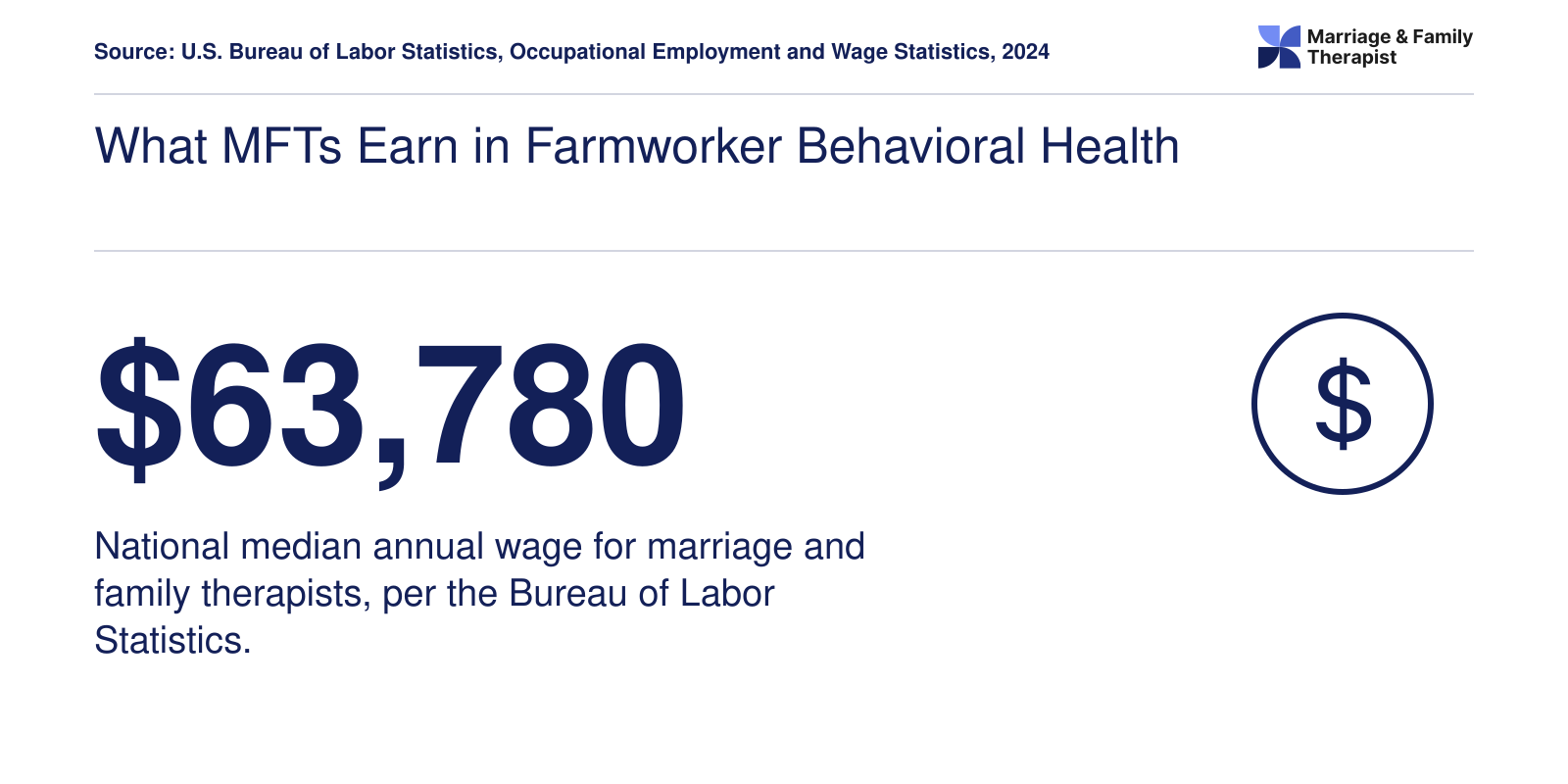
Base salaries for MFTs in federally qualified health centers and migrant health clinics commonly land between $70,000 and $85,000, which is at or above the national MFT median of roughly $63,780. While some early-career roles start closer to $60,000, total compensation climbs significantly when you factor in National Health Service Corps loan repayment awards of $50,000 to $75,000 in tax-free payments over two to three years. Rural farmworker communities often qualify as Health Professional Shortage Areas, which means faster job placement and stronger eligibility for these federal incentives. When you combine a competitive base salary with loan forgiveness, retirement contributions, and relocation stipends frequently offered by community health centers, this niche can rival or exceed what MFTs earn in higher-cost urban private practice settings.

What MFTs Earn in Farmworker Behavioral Health

Where to Find MFT Jobs in Migrant Health and Farmworker Clinics

Farmworker behavioral health roles rarely surface with the word "farmworker" in the job title. They appear as LMFT, bilingual therapist, or behavioral health consultant positions inside federally qualified health centers (FQHCs), county behavioral health departments, and rural community clinics. Knowing where to look, and which employers explicitly serve agricultural populations, cuts the search time dramatically.

Employers with a direct farmworker mission

A handful of organizations name migrant and seasonal farmworkers as a core population. Applying to these first gives you the shortest path into the niche.

  • San Mateo County Behavioral Health and Recovery Services (CA): Hires Psychiatric Social Worker/Marriage & Family Therapist I/II roles serving immigrants, Latinx youth and adults, migrant farmworkers, and rural working families. Postings typically appear on Indeed.1
  • United Health Centers of the San Joaquin Valley (CA): An FQHC network serving migrant and seasonal agricultural workers and their families. LMFT openings have been listed through Migrate Mate as recently as June 2026.
  • North Carolina Growers' Association: Represents nearly 10,000 H-2A farmworkers and contracts behavioral health support. Roles surface on LinkedIn, Indeed, and ZipRecruiter rather than a dedicated portal.3
  • KansasAgStress network clinics: Providers like Wichita Family Counseling see farm families through this statewide farm stress program.4

Job boards worth bookmarking

General boards work if you search carefully, but discipline-specific boards surface the roles faster.

  • Migrate Mate: A specialized MFT and mental health board. Recent listings have included United Health Centers of the San Joaquin Valley, LifeStance Health, Behavioral Health Practice Services, and Sutter Health.
  • AAMFT Job Connection: The national association's board, used by rural and migrant-serving programs.
  • AAMFT California Interest Network Job Board: State-level listings, valuable given California's concentration of agricultural employers.5
  • iHireMentalHealth: Posts LMFT roles from regional clinics such as Northeast Iowa Mental Health Center and Compassionate Counseling Services.6
  • Indeed and LinkedIn Jobs: Search "Licensed Marriage and Family Therapist" plus terms like "migrant," "FQHC," "bilingual," or the name of an agricultural county.78
  • ZipRecruiter: Lists rural behavioral health roles from employers like VitalCore Health Strategies.9

When a listing does not mention farmworkers in the title, read the population description carefully. Many rural FQHC roles serve agricultural families even when the posting never uses the word.

Pathway to Becoming an MFT for Farmworkers

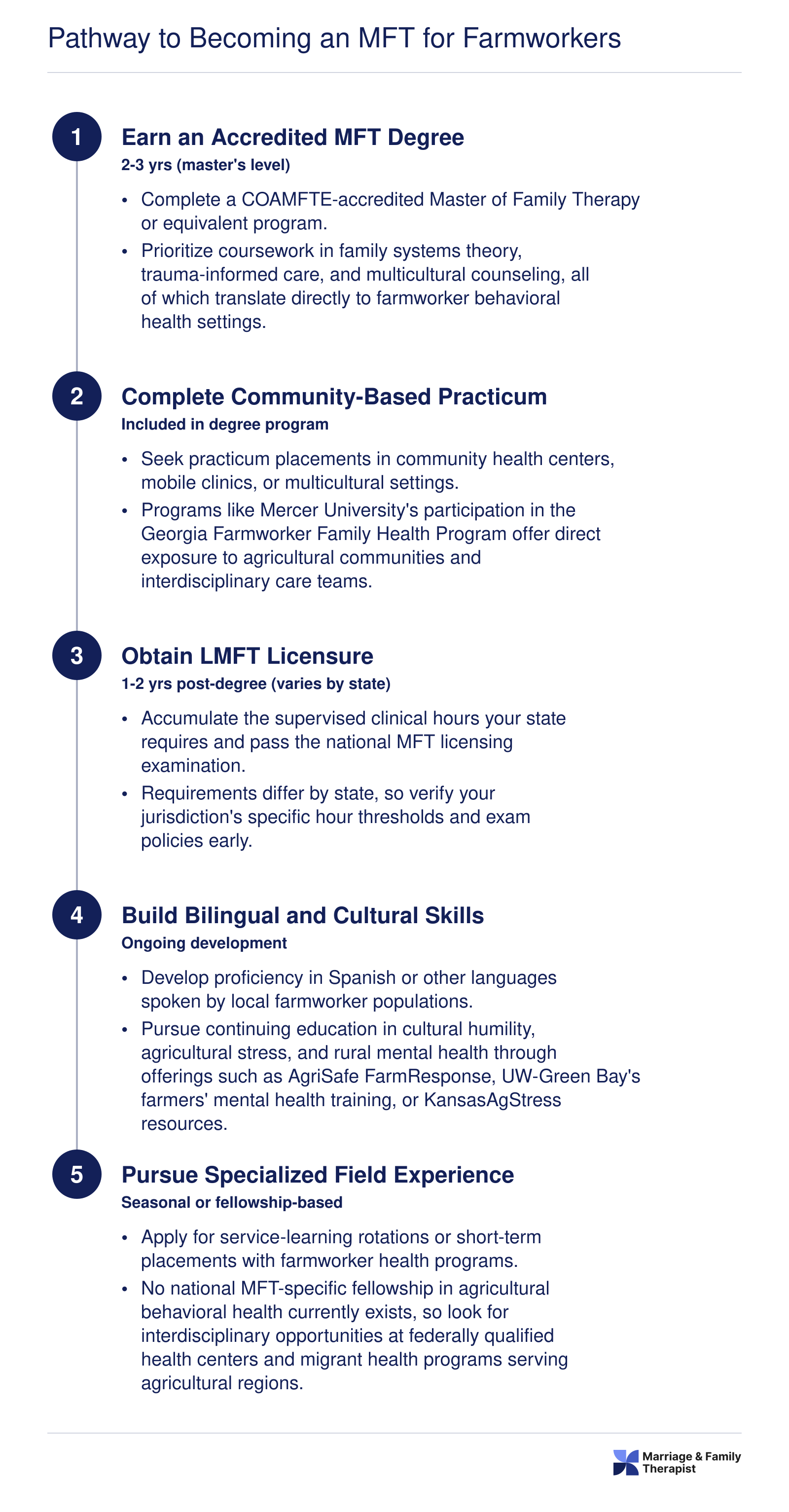
Moving from MFT student to licensed therapist serving farmworker communities follows a clear sequence, though the timeline varies by state and individual circumstances. Each stage builds on the last, so plan your coursework, clinical hours, and supplemental training with this niche in mind from the start.

Pathway to Becoming an MFT for Farmworkers

Funding and Sustainability: Grants, Reimbursement, and Telehealth

Farmworker behavioral health programs depend on a patchwork of federal grants, loan repayment incentives, clinic-level reimbursement, and telehealth infrastructure. Understanding how each piece fits together helps you evaluate whether a position is financially stable and whether you can leverage these resources to reduce your own student debt through financial aid for MFT students.

Federal Loan Repayment Programs for MFTs

The National Health Service Corps (NHSC) offers several loan repayment tracks that include marriage and family therapists as eligible clinicians. To qualify, you generally must work at an NHSC-approved site located in a Health Professional Shortage Area (HPSA). Three programs are especially relevant in 2026:

  • NHSC Rural Community Loan Repayment Program: Offers up to $100,000 for a three-year, full-time commitment at an approved rural site in a designated shortage area. Half-time commitments may qualify for up to $50,000.1
  • NHSC Substance Use Disorder Workforce Loan Repayment Program: Provides up to $75,000 over three years of full-time service at an NHSC-approved site focused on SUD treatment. Clinicians who pass a Spanish-language proficiency assessment may receive an additional $5,000 bonus, a notable incentive for bilingual MFTs serving farmworker populations.2
  • NHSC Loan Repayment Program (general track): Open to behavioral health providers, including MFTs, serving in mental health HPSAs. Award amounts may vary by program year.3

All three tracks use an annual online application cycle. State Loan Repayment Programs, which receive matching funds from HRSA of up to $50,000, offer another avenue for loan forgiveness for LMFT depending on whether your state includes behavioral health providers and rural placements.4

Clinic-Level Funding and Reimbursement

Most farmworker health centers operate as Federally Qualified Health Centers (FQHCs). This designation allows them to bill Medicaid and Medicare at enhanced reimbursement rates, which makes integrating an MFT into the care team financially viable for the organization. FQHCs also receive HRSA Section 330 grants that can fund behavioral health positions directly. Because integrated care models, where an MFT works alongside primary care providers, improve both patient outcomes and billing efficiency, clinics that embed behavioral health tend to sustain those positions more reliably than standalone programs.

Telehealth as a Funding and Access Strategy

Farmworkers are, by definition, a mobile population. Families move with harvest cycles, making continuity of care a persistent challenge. Telehealth bridges that gap by allowing MFTs to maintain therapeutic relationships across geography. Federal telehealth grants, such as those through HRSA's Rural Health Network Advancement Program, fund organizations rather than individual clinicians, with awards of up to $250,000 per year available across 40 recipients in FY 2026.5 HRSA's Rural Community Health Support Program allocated $4.5 million in 2026 with no local match requirement, lowering the barrier for smaller clinics.6

The value of telehealth equity in this space is already gaining national recognition. Mercer University faculty members Kimberly Roth and Janine Chalk-Wilayto received a Telehealth Equity Catalyst Award from the American Association of Medical Colleges in 2023 for their work promoting interprofessional learning, including the integration of MFT students into mobile and telehealth settings serving Georgia farmworkers.

Why Grant Writing Belongs in Your Skill Set

Many of the funding streams described above require organizational applications, not individual ones. That means if you can help a clinic write a competitive HRSA grant or structure a telehealth pilot proposal, you become exponentially more valuable as a hire. Grant-writing experience is rarely taught in MFT programs, but it can differentiate you in a tight job market MFT career paths and directly support the sustainability of the services you provide. Consider seeking continuing education in grant development early in your career, particularly if you plan to work in community-based or rural settings where funding cycles shape staffing decisions.

The NHSC Rural Community Loan Repayment Program offers licensed mental and behavioral health clinicians up to $100,000 in exchange for three years of full-time service treating substance use disorders at approved sites in rural Health Professional Shortage Areas. For MFTs willing to work in farmworker-serving clinics that meet these criteria, that award can wipe out most or all of a graduate school debt load. (Source: Congressional Research Service)

Frequently Asked Questions About MFT Careers in Farmworker Behavioral Health

Farmworker behavioral health is a growing but still unfamiliar career path for many marriage and family therapists. Below are answers to the questions prospective MFTs ask most often about working in this rewarding niche.

What is an MFT's role in a migrant health clinic?
MFTs on migrant health clinic teams deliver trauma-informed, culturally responsive therapy grounded in family systems theory. Day-to-day duties often include behavioral health screenings, psychoeducation, individual and family consultations, and crisis support. Because many clinics use mobile units or school-based sites, MFTs frequently provide care outside a traditional office, meeting farmworker families wherever they live and work.
Do I need to speak Spanish to work with farmworkers?
There is no legal requirement to speak Spanish, but most clinics strongly prefer or require it because many farmworkers have limited English proficiency. Interpreters or bilingual staff can sometimes bridge the gap, though their availability varies by site. Fluency in Spanish, Haitian Creole, or Indigenous languages spoken by agricultural workers will make you a far more competitive candidate and a more effective clinician.
What is the salary for MFTs in farmworker health centers?
Salary data specific to MFTs in farmworker settings is extremely limited.2 Compensation generally aligns with pay bands at federally qualified health centers (FQHCs) and community mental health agencies for master's-level therapists, which vary by region and funding model. Rural placements may offer lower base salaries but often offset the gap with loan repayment incentives, housing assistance, or other benefits. For a broader look, MFT salary data can provide a helpful benchmark.
Are there loan repayment programs available?
Yes. MFTs who work at approved sites such as FQHCs can qualify for federal loan repayment programs, including the National Health Service Corps (NHSC). Eligibility depends on holding a qualifying license, working at an approved service site, and committing to a minimum period of service. Requirements change from year to year and differ by state, so confirm current details with your clinic and state licensing board before relying on any specific program.
How do I find an internship in farmworker behavioral health?
No national database of farmworker behavioral health internships exists. The most reliable path is through university partnerships. For example, Mercer University's MFT program places students on mobile clinics and in school-based screenings through the Georgia Farmworker Family Health Program.1 Contact FQHC networks, academic medical centers, and faith-based organizations in agricultural regions directly, because available placements change every year.
What is the difference between MFT and LCSW in this setting?
Both MFTs and LCSWs can provide therapy for trauma, depression, and anxiety on interdisciplinary teams. A detailed comparison of LMFT and LCSW roles highlights that MFTs emphasize family systems and relational dynamics, which is especially valuable for addressing family separation and migration-related strain. LCSWs typically bring stronger training in case management and social determinants of health. In practice, job descriptions and program eligibility often depend more on the specific position and state regulations than on disciplinary title alone.

Recent News

Recent Articles