Southern Miss MFT students achieved a 100% pass rate on the AAMFTRB National Examination, far exceeding the typical 60% to 75% national range.
COAMFTE accreditation requires rigorous clinical and curricular standards that directly correlate with stronger exam outcomes.
Students complete over 300 hours of direct therapy at the Southern Miss Center for Family Therapy and community placements before graduating.
The Bureau of Labor Statistics projects 13% job growth for marriage and family therapists, with a national median salary of $63,780.
Every graduate seeking LMFT licensure must pass the AAMFTRB Marital and Family Therapy National Examination, a standardized test that filters out candidates who are not clinically or academically ready for independent practice. Nationally, first-time pass rates hover between 60% and 75%. That makes the University of Southern Mississippi's June 2026 announcement striking: every graduate in the program's master's cohort passed.1
That outcome did not happen by chance. The Southern Miss MFT program, housed in the College of Education and Human Sciences and accredited by the Commission on Accreditation for Marriage and Family Therapy (COAMFTE), combines rigorous coursework with 300 hours of direct client contact before graduation. Program coordinator Dr. Ben Jones credits a training model built around real clinical accountability, not just classroom preparation.
For prospective students evaluating how to become a licensed marriage and family therapist, a program's exam pass rate is one of the clearest proxies for how well it prepares graduates for licensure. In a field where demand for qualified therapists is rising and licensing boards are unforgiving about competency gaps, that number carries real weight.
What Is the AAMFTRB National MFT Examination?
First-time test takers often approach the national MFT exam with rigorous, structured preparation plans, while repeat takers sometimes rely more heavily on targeted review of weak content areas. Both pathways converge at the same checkpoint: the AAMFTRB Marital and Family Therapy National Examination, the standardized licensure test required by most states for MFT licensure exam eligibility.
The Association of Marital and Family Therapy Regulatory Boards (AAMFTRB) administers this high-stakes computer-based exam to evaluate whether graduates of accredited MFT programs possess the foundational knowledge and clinical judgment necessary for independent practice. The exam assesses competencies across domains that mirror the scope of marriage and family therapy practice, including assessment and intervention, ethics and professional identity, systems theory, human development, and research. Each of these content domains reflects the core curriculum taught in COAMFTE-accredited programs like Southern Miss.
Exam Format and Administration
The AAMFTRB national exam is delivered year-round at computer-based testing centers, offering candidates scheduling flexibility after they complete their graduate degree and clinical training requirements. The exam format typically includes multiple-choice questions that test both theoretical knowledge and applied clinical reasoning. Questions are scenario-based, requiring candidates to synthesize systemic thinking, ethical guidelines, and evidence-based interventions in realistic practice situations.
Candidates should consult the AAMFTRB official website (aamftrb.org) for the most current exam specifications, including the exact number of questions, time limit, and detailed content domain breakdowns. These specifications are published under the Exam Candidates or Publications sections and are updated periodically to reflect evolving practice standards in the field.
Understanding Pass Rates and Scoring
While the AAMFTRB does not publicly release a universal passing score or cut score, the exam is scaled to ensure consistent standards across administrations. Scaled scoring means that raw performance is adjusted to account for variations in exam difficulty, so a passing score represents the same level of competency regardless of when or where the test is taken.
National average pass rates for first-time and repeat takers are not widely published in a single public repository, but program-level data is often available through COAMFTE program outcome reports or state licensing boards. The U.S. Bureau of Labor Statistics Occupational Outlook Handbook for marriage and family therapists occasionally references licensure exam details, though it does not typically report granular pass rate data.
Where to Find Reliable Exam Data
Prospective students and current MFT candidates should pursue multiple sources to understand exam performance benchmarks:
AAMFTRB.org: The authoritative source for exam content outlines, registration procedures, and candidate handbooks.
State licensing boards: Many boards publish annual reports that include first-time and repeat pass rates for candidates trained in their jurisdiction.
Accredited MFT programs: Schools like Southern Miss often share their program-specific pass rates as part of transparency around student outcomes. Contact program coordinators directly for the latest data.
Reputable exam prep providers: Companies such as AATBS, TDC, and MFT Exam Prep offer unofficial summaries of exam format, typical content weighting, and study strategies. Cross-reference these resources with official AAMFTRB publications to ensure accuracy.
Understanding the exam structure and preparation landscape helps candidates calibrate their study plans and select programs with proven track records of exam success.
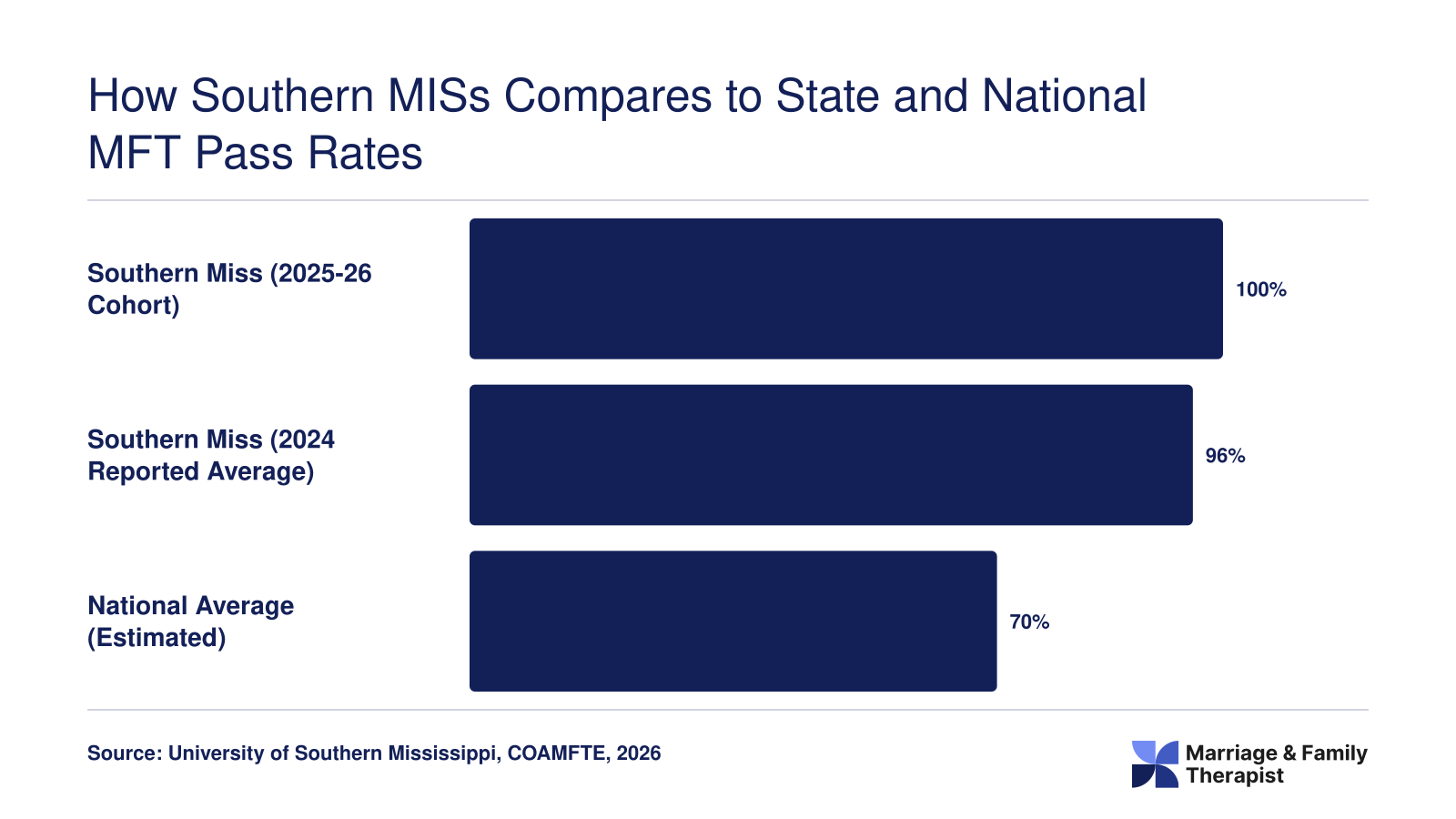
How Southern MISs Compares to State and National MFT Pass Rates
A 100% pass rate on the AAMFTRB National MFT Examination is exceptionally rare. Nationally, first-time pass rates for MFT candidates typically fall in the range of 60% to 75%, making the University of Southern Mississippi's achievement a clear standout. As the only COAMFTE-accredited MFT program in Mississippi, Southern Miss sets the benchmark for the entire state, and its most recent cohort outperformed both its own strong historical average and the broader national average by a wide margin.
Why COAMFTE Accreditation Matters for Exam Success
Not all graduate programs in marriage and family therapy are created equal, and the gap between accredited and non-accredited training has never been more consequential for licensure outcomes.
What COAMFTE Accreditation Actually Requires
The Commission on Accreditation for Marriage and Family Therapy Education sets a demanding bar for any program that earns its seal. COAMFTE accreditation requires programs to demonstrate:
A rigorous, theory-grounded curriculum aligned with current clinical practice
A minimum number of supervised direct client contact hours
Faculty who hold appropriate credentials and maintain active professional engagement
Systematic tracking of student outcomes over time
That last requirement is where the connection to exam performance becomes direct: programs must document how graduates perform on the national licensure examination and show they are meeting established benchmarks. If pass rates fall short, the program faces scrutiny and the real possibility of losing its accreditation status.
This built-in accountability loop means that a COAMFTE-accredited program has a structural incentive to prepare students thoroughly, not just to graduate them. The program's own standing depends on whether its graduates succeed on the national exam.
The Accreditation Credential You Should Prioritize
Southern Miss's MFT program, housed in the School of Human Development and Family Science within the College of Education and Human Sciences, holds COAMFTE accreditation.1 For prospective students, that credential matters well beyond institutional prestige. Many state licensing boards give preferential consideration to graduates of COAMFTE-accredited programs. In Mississippi, for example, understanding LMFT license Mississippi requirements reveals how tightly accreditation and licensure eligibility are linked. In some states, graduation from an accredited program is a hard requirement before a candidate can even sit for the national examination.
The Risk of Skipping Accreditation
Graduates of non-accredited MFT programs can face significant barriers when they apply for licensure. Some states require additional supervised hours, supplementary coursework, or a formal equivalency review before they will accept a non-accredited degree. That process can add months or years to the path to becoming a licensed marriage and family therapist, and in some cases applicants are simply turned away. When weighing your options, understanding the differences outlined in a COAMFTE vs CACREP comparison can help clarify which credential aligns with your career goals. Choosing a COAMFTE-accredited program from the start closes those gaps before they open.
As Dr. Ben Jones, coordinator of the Southern Miss MFT program, puts it: 'The need for high-quality therapists has never been higher.' That urgency shapes everything about the program, which is built not just to award degrees but to produce graduates who are fully prepared to sit for licensure and step into practice on day one.
Inside the Clinical Training Model: 300+ Hours of Direct Therapy
The Marriage and Family Therapy master's program at Southern Miss does not simply teach theory. It builds clinicians through intensive, hands-on practice. The 100% pass rate on the AAMFTRB National Examination reflects a training model where students spend hundreds of hours engaged in real therapeutic work before they ever sit for the exam.1
The 300-Hour Clinical Requirement: Direct Client Contact, Not Observation
When the program outlines 300 hours of direct therapy services, it means face-to-face, client-contact hours. These are not observation sessions, role-playing exercises, or classroom simulations. Each hour represents a student sitting with an individual, couple, or family, conducting assessment, intervention, and ongoing treatment under supervision. This depth of direct practice builds the clinical judgment, adaptability, and therapeutic presence that the national exam measures. By the time a student graduates, they have already navigated hundreds of real clinical moments (crises, breakthroughs, and the nuanced work of relational therapy) that no multiple-choice question can fully replicate.
Two Training Environments: On-Campus Clinic and Community Placements
The clinical hours are earned across two complementary settings, each contributing distinct competencies. First, students train at the Southern Miss Center for Family Therapy, the program's on-campus clinic. Here, they work with clients from the local community in a structured, closely supervised environment. Faculty supervisors observe sessions through one-way mirrors, provide immediate feedback, and guide case formulation. The clinic setting emphasizes foundational skills: developing treatment plans, managing session flow, and building therapeutic alliances.
Second, students complete community placements at agencies, hospitals, or private practices throughout the region. These external sites expose trainees to a broader range of presenting problems, socioeconomic contexts, and clinical modalities. A student might work with a homeless family one afternoon and a blended family navigating custody the next. This dual-structure model ensures graduates are not only technically skilled but also culturally responsive and agile in diverse professional settings. Programs like the Auburn University MFT program use a similar practicum-intensive approach, reinforcing the value of direct client hours.
Institutional Investment: Faculty Leadership and Support
The clinical model is anchored by robust faculty leadership. Dr. Ben Jones, MFT program coordinator, oversees curriculum and clinical placement quality, ensuring every student meets the rigorous hour thresholds with meaningful experiences. His role is central to maintaining the program's accreditation and exam preparedness. Dr. Heath Grames directs the School of Human Development and Family Science, fostering interdisciplinary collaboration and resources that enrich the MFT track. At the college level, Dr. Trent Gould, Dean of the College of Education and Human Sciences, champions the program's mission, securing the institutional support necessary for clinic operations, community partnerships, and student scholarships. Prospective students exploring MFT scholarships should note that this kind of layered investment often translates into tangible financial support for trainees. Southern Miss does not treat clinical training as a checkbox; it is the core of MFT education.
A Graduate Profile: Lexi Nelson's Path to Excellence
Lexi Nelson, named Outstanding Marriage and Family Therapy Student for the 2025-26 academic year, embodies the model's outcomes. Originally from Bozeman, Montana, Nelson completed her degree in May 2026 after immersing herself in the full 300-hour clinical sequence.1 Faculty note her ability to integrate complex theory with compassionate practice, a direct result of working extensively in both the on-campus clinic and community placements. Her recognition is not an isolated honor; it highlights the type of practitioner this program consistently develops: confident, ethically grounded, and fully prepared for licensure.
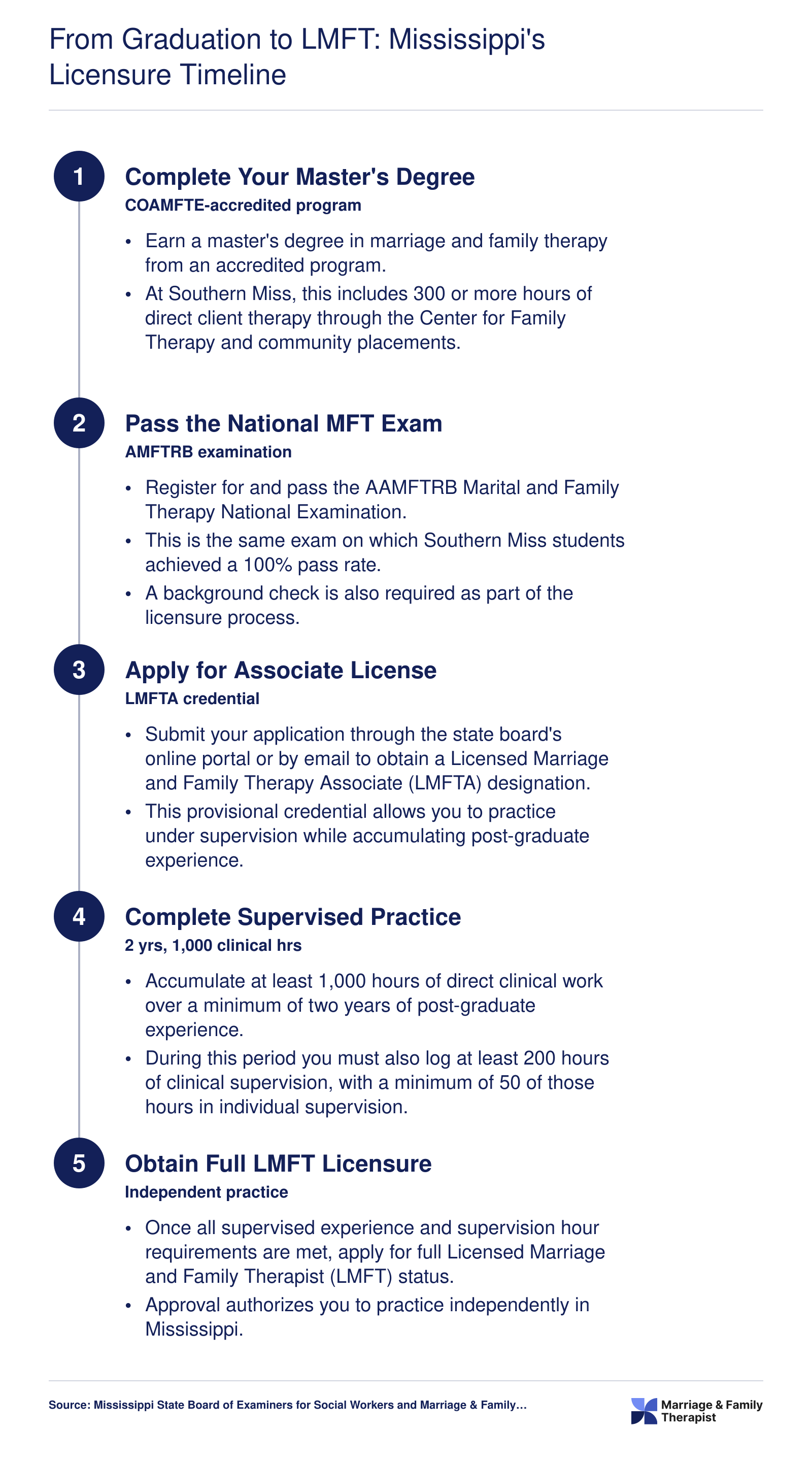
From Graduation to LMFT: Mississippi's Licensure Timeline
After completing a COAMFTE-accredited master's program like the one at Southern Miss, graduates in Mississippi follow a structured credentialing path overseen by the Mississippi State Board of Examiners for Social Workers and Marriage & Family Therapists. The full journey from diploma to independent LMFT practice typically spans two to three years, with the post-degree supervised experience phase being the longest segment.
Questions to Ask Yourself
Are you choosing an MFT program based on exam outcomes, or mainly on location and convenience?
Programs with documented high pass rates signal stronger preparation for licensure. Choosing convenience over outcomes can mean more time and money spent on remediation or repeat exam attempts after graduation.
Have you confirmed that the program you are considering holds COAMFTE accreditation?
COAMFTE accreditation is required for licensure eligibility in many states, including Mississippi. Enrolling in a non-accredited program may disqualify your degree for the national exam entirely.
Do you know how many direct client-contact hours the program requires before graduation?
Clinical hours build the applied skills that national exam questions test. Programs requiring fewer hours may leave graduates underprepared, even if coursework is otherwise strong.
How to Prepare for the National MFT Exam
Strong clinical experience and dedicated exam preparation are two different things. Southern Miss graduates built their foundation through 300-plus hours of direct therapy, but every MFT candidate, regardless of program, still needs a focused study plan to convert clinical instincts into exam-ready knowledge.
Understand What You Are Up Against
The AMFTRB national MFT exam consists of 180 questions to be completed in four hours.1 Roughly 40 percent of the exam focuses on theory and ethics, so candidates who underweight those domains in favor of clinical content are leaving points on the table.2 The exam also includes a mark-and-review feature, which lets you flag uncertain questions and return to them. That is a small but meaningful tactical advantage if you practice using it.
Choose Your Prep Resources Carefully
The best prep materials are aligned to the official AMFTRB content blueprint and balance content review with genuine test-taking skill development.3 A few well-regarded options in 2026:
AMFTRB Official Practice Examination: The closest simulation of the real exam. Completing it under timed conditions is non-negotiable.4
AATBS National MFT Exam Prep: Offers a bank of approximately 1,200 practice questions with detailed rationales, widely used by candidates seeking comprehensive domain coverage.5
Mometrix MFT Online Prep Course: Includes a free 180-question practice test, making it easy to benchmark your readiness before committing to a full course.1
Tests.com MFT Practice Exam: A 500-question bank suited for targeted domain review.6
MFT National Exam Prep 2026 App: Available on the Apple App Store with around 1,500 questions and 300 flashcards, useful for study sessions on the go.7
TAMFT Exam Prep Workshop: A structured workshop format for candidates who prefer facilitated review.8
2026 MFT Exam Prep Facebook Group: A peer community for shared strategies, moral support, and real-time questions from candidates currently in the process.9
Build a Study Timeline That Actually Works
Most candidates who pass on the first attempt spend eight to ten weeks preparing.2 A practical breakdown looks like this:
Weeks one and two: Audit your baseline. Take a diagnostic practice test, identify your weakest domains, and map your remaining study time against the content outline.
Weeks three through six: Deep content review, domain by domain. Prioritize theory, ethics, and assessment. Use spaced repetition techniques, reviewing difficult material at increasing intervals rather than cramming the same notes repeatedly.
Weeks seven and eight: Shift almost entirely to timed, full-length practice exams. Simulate real testing conditions: no interruptions, four-hour blocks, no open notes.
Weeks nine and ten: Light review of persistent weak spots, rest, and logistics.
Successful candidates typically invest ten to fifteen hours per week across this window. Study groups can reinforce retention, especially for theory application questions where discussing clinical scenarios out loud surfaces gaps that solo review misses.
Bridge the Clinical-to-Exam Gap
Intensive programs like Southern Miss's give graduates a genuine advantage because the underlying conceptual knowledge is already internalized through practice. However, the exam tests that knowledge in a specific multiple-choice format that rewards decision-rule thinking: the ability to identify the single best response among plausible alternatives under time pressure.2 Practicing decision-rule strategies, where you systematically eliminate options based on theoretical alignment and ethical priority, is a separate skill worth developing deliberately. Candidates preparing for their LMFT license requirements by state should also confirm which version of the exam their licensing board accepts, as administrative details like these can easily slip through the cracks during study mode.
MFT Career Outlook and Salary in Mississippi
Understanding the earning potential and job market for licensed marriage and family therapists helps prospective students make informed decisions about their career investment. The Bureau of Labor Statistics projects 13% job growth for marriage and family therapists from 2024 to 2034, a rate characterized as much faster than average, with roughly 7,700 openings expected annually nationwide. The salary figures below reflect the broader MFT occupation across all employers and experience levels, not outcomes specific to any single program such as Southern Miss.
Metric
Mississippi
National Context
Total Employment
180
71,200 (2022)
Median Annual Salary
$51,260
Reported by BLS for SOC 21-1013
25th Percentile Salary
$50,410
Reported by BLS for SOC 21-1013
75th Percentile Salary
$52,680
Reported by BLS for SOC 21-1013
Mean Annual Salary
$51,480
Reported by BLS for SOC 21-1013
Projected Job Growth (2024 to 2034)
Not reported at state level
13% (much faster than average)
Projected Annual Openings (2024 to 2034)
Not reported at state level
Approximately 7,700
The U.S. Bureau of Labor Statistics reports a national median salary of $63,780 for marriage and family therapists, with employment in the field projected to grow faster than average. For graduates entering practice fully prepared, that combination of earning potential and job demand makes the career case clear.
Frequently Asked Questions About MFT Exam Pass Rates
Prospective MFT students often have questions about what the national licensing exam involves, how to prepare, and what sets certain programs apart. Below are answers to the most common questions, informed by the latest results from the University of Southern Mississippi and current Mississippi licensure standards.
What is the pass rate for the national MFT exam?
National pass rates for the AAMFTRB Marital and Family Therapy National Examination typically hover around 70% on first attempts, though exact figures fluctuate year to year and vary by program. The University of Southern Mississippi's MFT program achieved a 100% pass rate for its 2025 to 2026 graduating cohort, a result that significantly exceeds the national average and underscores the effectiveness of its curriculum and clinical training model.
How many questions are on the AAMFTRB MFT national examination?
The AAMFTRB Marital and Family Therapy National Examination contains 200 multiple choice questions. Of those, a portion are unscored pilot items used for future test development. The exam covers domains including the practice of marriage and family therapy, ethical and legal standards, assessment and diagnosis, and treatment planning. Candidates are allotted four hours to complete the exam.
Is the MFT exam hard to pass?
The exam is considered challenging. It tests both theoretical knowledge and clinical judgment across a broad range of therapeutic models and ethical scenarios. Because roughly three out of every ten first time test takers do not pass nationally, solid preparation is essential. Students graduating from COAMFTE accredited programs with intensive clinical hours, like the 300 plus hours completed at Southern Miss, tend to be better positioned for success.
What is the best way to study for the national MFT exam?
Effective preparation combines structured review of core MFT theories, systems thinking, ethical standards, and DSM diagnostic criteria. Many successful candidates use commercial study programs, practice exams, and peer study groups. Programs like Southern Miss embed exam readiness into their coursework and supervised clinical training, so students build competency continuously rather than relying solely on last minute review. Consistent practice with timed, scenario based questions is especially useful.
What are the requirements for MFT licensure in Mississippi?
Mississippi requires candidates to hold a master's or doctoral degree in marriage and family therapy from a program that meets state educational standards, ideally one accredited by COAMFTE. Applicants must complete supervised clinical experience, pass the AAMFTRB national examination, and submit a licensure application to the Mississippi State Board of Examiners for Licensed Professional Counselors. Specific hour requirements for direct client contact and post degree supervision apply.
How does the Southern Miss MFT program compare to other Mississippi programs?
Southern Miss stands out as a COAMFTE accredited program housed in the College of Education and Human Sciences. Its 100% national exam pass rate for the 2025 to 2026 academic year places it at the top among Mississippi MFT programs. Students complete at least 300 hours of direct therapy services through the Southern Miss Center for Family Therapy and community placements, providing a depth of hands on clinical experience that directly correlates with exam and career readiness.
Southern Miss's 100% pass rate on the AAMFTRB National Examination is not a fluke. It is the direct result of COAMFTE accreditation standards, 300-plus hours of supervised direct therapy, and faculty who treat licensure readiness as a core program mission.1 In a field where national first-time pass rates hover between 60% and 75%, that gap speaks for itself.
If you are comparing MFT programs, prioritize pass rates and clinical training depth over convenience or cost alone. Use side-by-side program comparisons to evaluate accreditation status, clinical hour requirements, and faculty investment before committing to any program.