The University of Central Missouri and Saint Louis University offer Missouri's only COAMFTE-accredited MFT master's programs.
Missouri requires 3,000 hours of supervised post-degree clinical experience before granting full LMFT licensure.
MFT job growth in Missouri is projected at roughly 15% through 2032, well above the average for all occupations.
Accreditation from either COAMFTE or CACREP is essential because unlisted programs can block your Missouri licensure path entirely.
Missouri's Bureau of Labor Statistics projections estimate roughly 15% job growth for marriage and family therapists through 2032, well above the average for all occupations. Yet the state has only a handful of accredited graduate programs that directly qualify graduates for LMFT licensure, creating a tight pipeline of new clinicians entering the field.
That scarcity makes program selection high-stakes. Missouri's licensing board requires specific coursework hours, supervised clinical experience, and an approved examination, and not every graduate degree in counseling or therapy checks those boxes. Choosing a program with the wrong accreditation, or one that falls short on required content areas, can add years to your timeline. Understanding accreditation distinctions, especially between COAMFTE and CACREP, is essential before committing tuition dollars.
Best MFT Programs in Missouri: 2026 Rankings
Missouri offers a small but focused set of graduate programs for aspiring marriage and family therapists. The state's COAMFTE-accredited master's programs at the University of Central Missouri and Saint Louis University remain the clearest paths to LMFT licensure, while the University of Missouri-St. Louis provides a complementary graduate certificate for counselors who want couple and family specialization. Below, we rank the programs available to Missouri students in 2026 based on accreditation standing, program depth, institutional outcomes, and affordability.
NCES-IPEDS federal institutional data — nces.ed.gov
Independent program research
University of Missouri-St Louis
#1
Saint Louis, MO · $15,000 – $20,000/yr
Best for: Licensed counselors adding family specialization
The University of Missouri-St. Louis is a public research institution in the University of Missouri System serving the greater St. Louis metro area. Known for its urban mission and commitment to diverse, underserved communities, UMSL pairs affordable public university tuition with practical, community-embedded training. Its College of Education houses counseling programs that leverage a broad network of clinical placement sites across the region, giving students direct exposure to family and couple dynamics in real-world settings.
Graduate Certificate in Couple, Marriage, and Family Counseling — On-Campus
12-credit-hour certificate for mental health professionals
Supervised clinical experience at St. Louis area sites
Courses focus on couple, family, and systems interventions
Designed to complement LPC licensure, not standalone LMFT
Evening scheduling accommodates working professionals
Fall (Jul 1), Spring (Dec 1), Summer (May 1) deadlines
Requires 3.0 GPA and two recommendation letters
Includes telehealth counseling exposure in supervised practice
COAMFTE Vs. CACREP Accreditation: What Missouri Students Should Know
Choosing the right accreditation type is one of the most consequential decisions you will make when selecting an MFT program. Two organizations dominate the landscape: COAMFTE, which accredits programs exclusively in marriage and family therapy, and CACREP, which accredits a broader range of counseling specializations, including a Marriage, Couples, and Family Counseling track. Understanding how each one aligns with Missouri's licensure framework can save you time, money, and frustration down the road.
How the Two Accreditors Differ
COAMFTE programs are built around systemic and relational therapy from the ground up. Every required course, clinical placement, and supervision hour is designed specifically for aspiring marriage and family therapists. CACREP programs, by contrast, train students across multiple counseling domains and offer a couples and family specialty within that wider curriculum. Both paths can lead to strong clinical preparation, but the depth of MFT-specific content tends to be more concentrated in COAMFTE-accredited programs.
Key comparison points:
Curriculum focus: COAMFTE centers on systemic and relational models; CACREP covers broader counseling theory with a family therapy track.
Supervised experience: Both require 3,000 total supervised hours, including 1,500 hours of direct client contact, for Missouri LMFT licensure.4
Licensing exam: Graduates of either accreditation type must pass the AMFTRB Examination in Marital and Family Therapy.3
National portability: COAMFTE credentials tend to transfer more uniformly across state lines. CACREP graduates may face additional course-by-course reviews in certain states.
What Missouri's Licensing Board Accepts
Missouri's Committee for Professional Counselors, operating under regulations outlined in 20 CSR 2233-2.010, accepts graduates of both COAMFTE and CACREP-accredited programs for LMFT licensure.2 Neither accreditation requires an additional course grid review, which means graduates of either pathway can move directly into the supervised practice phase without supplemental coursework, assuming all degree requirements are met. If you are weighing the broader differences between these two career tracks, a detailed look at LMFT vs LPC credentials can help clarify which path best fits your goals.
Which Missouri Programs Hold Each Accreditation
Among Missouri-based institutions, Evangel University and Saint Louis University offer COAMFTE-accredited programs, giving students direct access to MFT-specific training within the state. Several other Missouri universities offer CACREP-accredited counseling programs with a marriage and family track. Additionally, a growing number of COAMFTE and CACREP-accredited programs from out-of-state institutions are available in online or hybrid formats, expanding options for students who need scheduling flexibility. You can compare many of these options through a comprehensive list of online MFT degrees.
The Bottom Line for Missouri Students
Both accreditation paths lead to LMFT licensure in Missouri without requiring a supplemental course review, so neither choice will disqualify you.2 The decision ultimately comes down to career goals. If you plan to practice exclusively as a marriage and family therapist and may relocate to another state in the future, COAMFTE accreditation offers the smoothest path. If you want versatility across counseling roles or are drawn to a program that blends family therapy with other clinical disciplines, a CACREP-accredited program is a strong alternative. Either way, confirm that any program you are considering holds current accreditation status or is within its pre-accreditation window, which can extend up to two years, before you enroll.2
Questions to Ask Yourself
Can you attend classes during traditional daytime hours, or do you need evening, weekend, or online flexibility?
Full-time workers often need asynchronous or evening coursework to avoid career disruptions. Choosing the wrong format can stretch a two-year program into four or lead to burnout.
Are you able to relocate or commute for practicum placements, or do you need clinical hours close to home?
Some Missouri programs arrange local practicum sites, while others expect students to secure placements independently. If relocating is not an option, confirm that a program supports supervised hours in your area before you apply.
Is COAMFTE accreditation essential for your career goals, or would a CACREP-accredited program satisfy Missouri's licensure requirements?
Missouri accepts graduates from both COAMFTE and CACREP programs for LMFT licensure, but certain employers, military positions, or out-of-state boards may prefer or require COAMFTE credentials specifically. Clarifying this now prevents costly detours later.
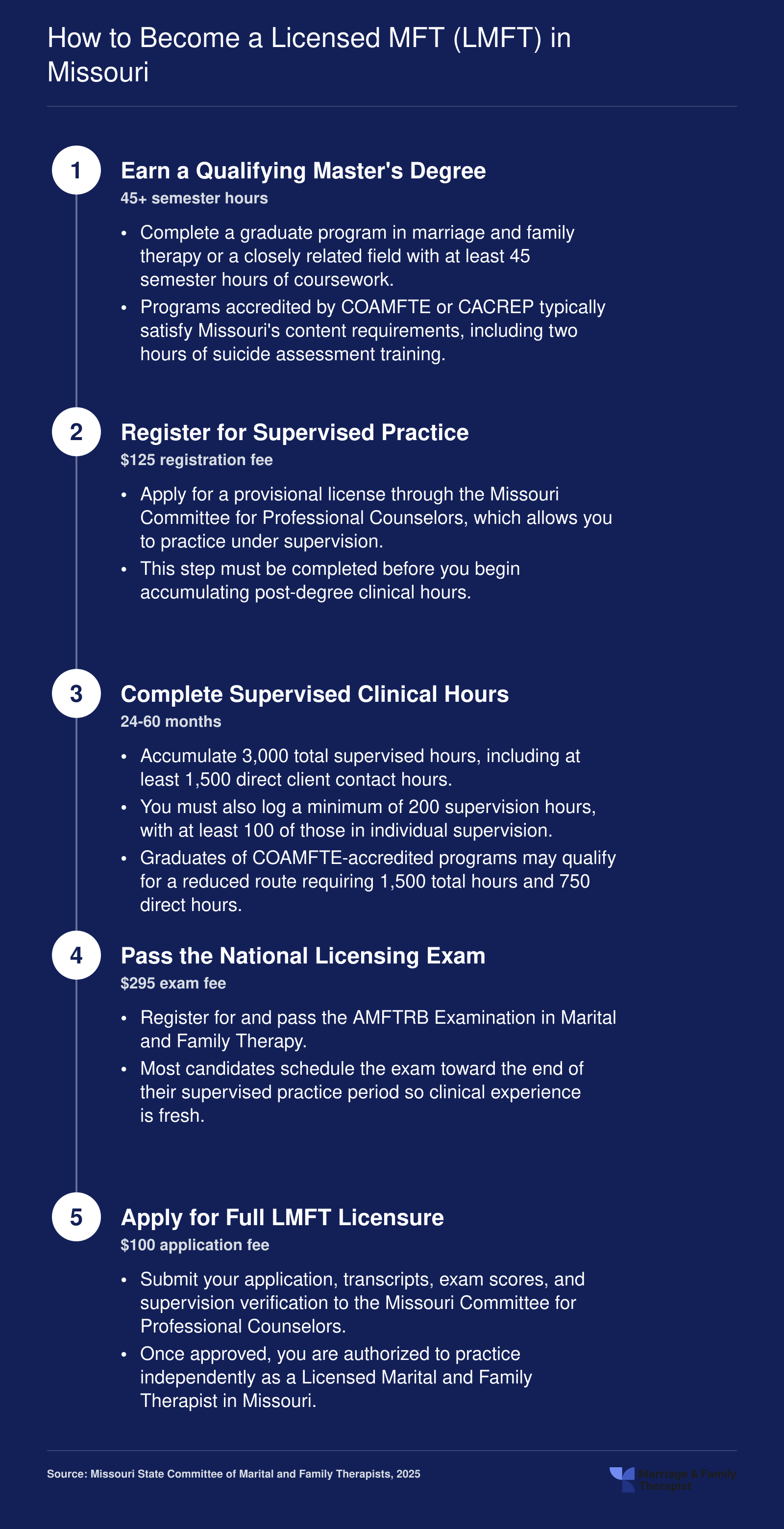
How to Become a Licensed MFT (LMFT) in Missouri
Earning your LMFT in Missouri is a structured but demanding process that typically takes four to seven years from the start of graduate school through full licensure. The most common pitfalls are choosing a program that falls short of the 45-credit-hour minimum, underestimating the two-year supervision timeline, or letting exam registration lapse. Planning each phase in advance keeps you on the fastest path to independent practice.
Missouri LMFT Licensure Requirements: The Details
Earning a license as a Marital and Family Therapist in Missouri involves meeting specific benchmarks in education, supervised practice, and examination.1 Below is a closer look at each requirement so you can plan your path with confidence.
Coursework and Degree Requirements
Missouri requires a master's, specialist, or doctoral degree comprising at least 45 semester hours of graduate coursework.1 The state mandates coverage across defined content areas:
Human development: 6 semester hours
MFT theory: 3 semester hours
Professional ethics: 3 semester hours
Research: 3 semester hours
Diagnosis and assessment: 3 semester hours
Clinical practice: 12 semester hours
Practicum or internship: 6 semester hours (completed within the degree program)
If your program holds COAMFTE accreditation, or CACREP accreditation in the marriage, couple, and family counseling specialty area, Missouri considers the educational requirement automatically satisfied.1 That streamlined path can simplify the application process considerably.
Post-Degree Supervised Experience
After graduating, you must accumulate 3,000 hours of supervised clinical work, including at least 1,500 hours of direct client contact.1 This experience must span a minimum of 24 months and cannot exceed 60 months, with at least 15 hours of clinical activity logged each month.
During that period you also need 200 total hours of clinical supervision, of which at least 100 must be individual (one-on-one) supervision.1 Supervision sessions must occur at a frequency of one hour per week or two hours every two weeks. Your supervisor must meet qualifications set by the Missouri Committee of Marital and Family Therapists, so verify credentials before you begin logging hours. For a broader look at what supervised training involves, see our guide on what to expect in an MFT clinical internship.
The AMFTRB National Examination
Missouri requires a passing score on the Examination in Marital and Family Therapy, administered by the Association of Marital and Family Therapy Regulatory Boards (AMFTRB).1 The exam is a multiple-choice, computer-based test covering clinical concepts, ethics, and treatment approaches central to MFT practice. You register through the AMFTRB and can schedule your sitting at an approved testing center. If you do not pass on your first attempt, retake policies are governed by the AMFTRB; check their current guidelines for waiting periods and fees. A background check and application fee are also part of the Missouri licensure process.
Licensure Portability and Online Program Considerations
Missouri offers a reciprocity pathway for therapists already licensed in another state.3 Through verification of your existing credentials and score endorsement, you may qualify without repeating every step from scratch. This is a meaningful advantage if you relocate. Our overview of LMFT license requirements by state provides additional context on how Missouri compares to other states.
However, prospective students should be aware of an important restriction: Missouri does not accept degrees earned primarily through correspondence or predominantly online coursework for LMFT licensure. If you are considering a fully online program from an out-of-state institution, confirm directly with the Missouri Committee of Marital and Family Therapists that the program's delivery format will be accepted before you enroll. Programs that blend online instruction with substantial in-person clinical components may fare differently than those delivered entirely at a distance, but the burden of verification falls on the applicant.
For the most current application forms, fee schedules, and supervisor approval procedures, consult the Missouri Division of Professional Registration and resources provided by AAMFT.
Online and Hybrid MFT Programs Available to Missouri Students
Missouri residents who need scheduling flexibility often look beyond the state's in-person offerings. While the University of Missouri-St. Louis provides a campus-based Graduate Certificate in Couple, Marriage, and Family Counseling, it is not a full master's degree, and no ranked Missouri program in our directory currently lists an online or hybrid master's format. That reality sends many prospective students to out-of-state online programs, a path that can work well if you choose carefully.
Out-of-State Online Programs Worth Evaluating
Several nationally enrolling online MFT programs accept Missouri residents. National University offers a COAMFTE-accredited MA in Marriage and Family Therapy delivered entirely online, making it one of the stronger distance options for students who want accreditation aligned with Missouri's licensing expectations. Friends University holds COAMFTE accreditation as well, though its program is campus-based in Kansas rather than fully online.2
Grand Canyon University markets an online Clinical Mental Health Counseling degree that sometimes appears in MFT-related searches, but it does not carry COAMFTE accreditation and its curriculum centers on clinical mental health counseling rather than marriage and family therapy specifically.2 Missouri students considering that route should confirm with the state licensing board whether the coursework satisfies the 45-semester-hour MFT educational requirement before enrolling.
The Clinical Hour Challenge
Even the most flexible online program cannot eliminate in-person clinical training. Missouri requires supervised practicum experience as part of the educational component, and the state's 3,000-hour post-degree supervised practice requirement means you will need reliable access to local clinical sites. Before committing to any distance program, verify that it has existing practicum partnerships in your part of Missouri or that it permits you to arrange your own approved site. Students in rural areas should be especially proactive, because placement options thin out quickly outside the Kansas City and St. Louis metro areas.
Accreditation Is Non-Negotiable for Licensure
Missouri's licensing framework assumes that graduates of COAMFTE-accredited programs meet the educational standard.3 Programs accredited by CACREP may also qualify if the coursework covers core MFT content areas, but online programs that lack both COAMFTE and CACREP accreditation put you at risk of having your application denied or delayed. The simplest way to protect your investment is to confirm accreditation status through the COAMFTE accredited programs directory or the AAMFT's list of accredited programs before you apply.
Practical Steps Before You Enroll
Check accreditation first: Look up the program in the COAMFTE or CACREP directories to confirm active accreditation status.
Contact the Missouri licensing board: Ask whether graduates of your target program have successfully obtained the LMFT credential in the state.
Confirm practicum logistics: Request a list of approved clinical sites in Missouri, or ask about the process for proposing your own placement.
Compare total costs: Online tuition varies widely, and out-of-state programs do not always charge less than Missouri's public universities once fees are included.
Online learning can be a smart path to the LMFT, but only when the program's accreditation, curriculum, and clinical training infrastructure align with what Missouri demands. For a broader look at distance options, explore our directory of best online MFT programs.
Accreditation is the single most important factor when choosing an MFT program. Enrolling in a program that lacks COAMFTE or CACREP accreditation can delay or completely block your path to Missouri LMFT licensure, costing you valuable time and money. Before you commit to any program, verify its current accreditation status directly with the accrediting body.
MFT Salary and Job Outlook in Missouri
Understanding what you can expect to earn as a licensed marriage and family therapist in Missouri helps you weigh the return on investment for your MFT degree. The good news: Missouri's MFT compensation is competitive, and demand for qualified therapists continues to grow across the state.
Missouri MFT Salary by Percentile
According to the most recent Bureau of Labor Statistics wage data for Marriage and Family Therapists (SOC 21-1013), Missouri professionals earn the following annual wages:1
10th percentile: $37,000 to $39,000 per year (approximately $18 to $19 per hour)
25th percentile: $43,000 to $46,000 per year (approximately $21 to $22 per hour)
Median: $64,900 per year (approximately $31 to $32 per hour)
75th percentile: $83,000 to $86,000 per year (approximately $40 to $41 per hour)
90th percentile: $115,000 to $118,000 per year (approximately $56 to $57 per hour)
The wide range from entry-level to top-tier earnings reflects differences in practice setting, specialization, years of experience, and whether a therapist operates in private practice versus agency-based work. Clinicians who build a full private caseload or take on supervisory roles typically land in the upper quartiles.
How Missouri Compares to the National Median
The national median annual wage for marriage and family therapists sits near $58,000 to $60,000, which means Missouri's median of $64,900 outpaces the national figure by several thousand dollars.2 That differential is even more significant when you factor in Missouri's lower cost of living relative to states like California and New York, where MFT salary by state figures may appear higher on paper but stretch less in practice. Missouri-based LMFTs often enjoy stronger purchasing power than peers in coastal markets.
Metro Area Salary Breakdown
Compensation varies across Missouri's metro regions. The Kansas City and St. Louis metropolitan areas, which house the state's largest healthcare systems and behavioral health networks, tend to offer the highest wages for MFTs. Both metros benefit from robust demand driven by large, diverse populations and extensive insurance-based referral networks.
Springfield, serving as a regional hub for the Ozarks, also reports a meaningful concentration of MFT positions, though wages may trend slightly below the two largest metros. Columbia, home to the University of Missouri health system, offers employment opportunities connected to university counseling centers and affiliated clinics. Exact metro-level wage figures fluctuate between reporting periods, so checking the latest BLS area estimates before you commit to a location is a smart move.
Job Growth and Employment Outlook
Missouri's employment projections for marriage and family therapists point to steady growth through the end of this decade. Nationally, BLS projects the MFT occupation to grow faster than average, and Missouri mirrors that trend. Increasing public awareness of mental health, expanded insurance coverage for therapy services, and a cultural shift toward seeking professional help for relationship challenges all fuel demand.
State labor data indicates a healthy number of projected annual openings across Missouri, driven by both new positions and the need to replace therapists who retire or transition to other roles. Rural and underserved communities in particular face therapist shortages, creating opportunities for newly licensed professionals willing to practice outside the Kansas City and St. Louis corridors. For a broader look at what this profession entails day to day, explore the full marriage and family therapist job outlook.
If you are weighing the financial viability of an MFT career in Missouri, the numbers paint an encouraging picture. A median salary that exceeds the national benchmark, combined with a favorable cost of living and growing employer demand, positions Missouri as one of the more practical states in which to launch or advance your practice.
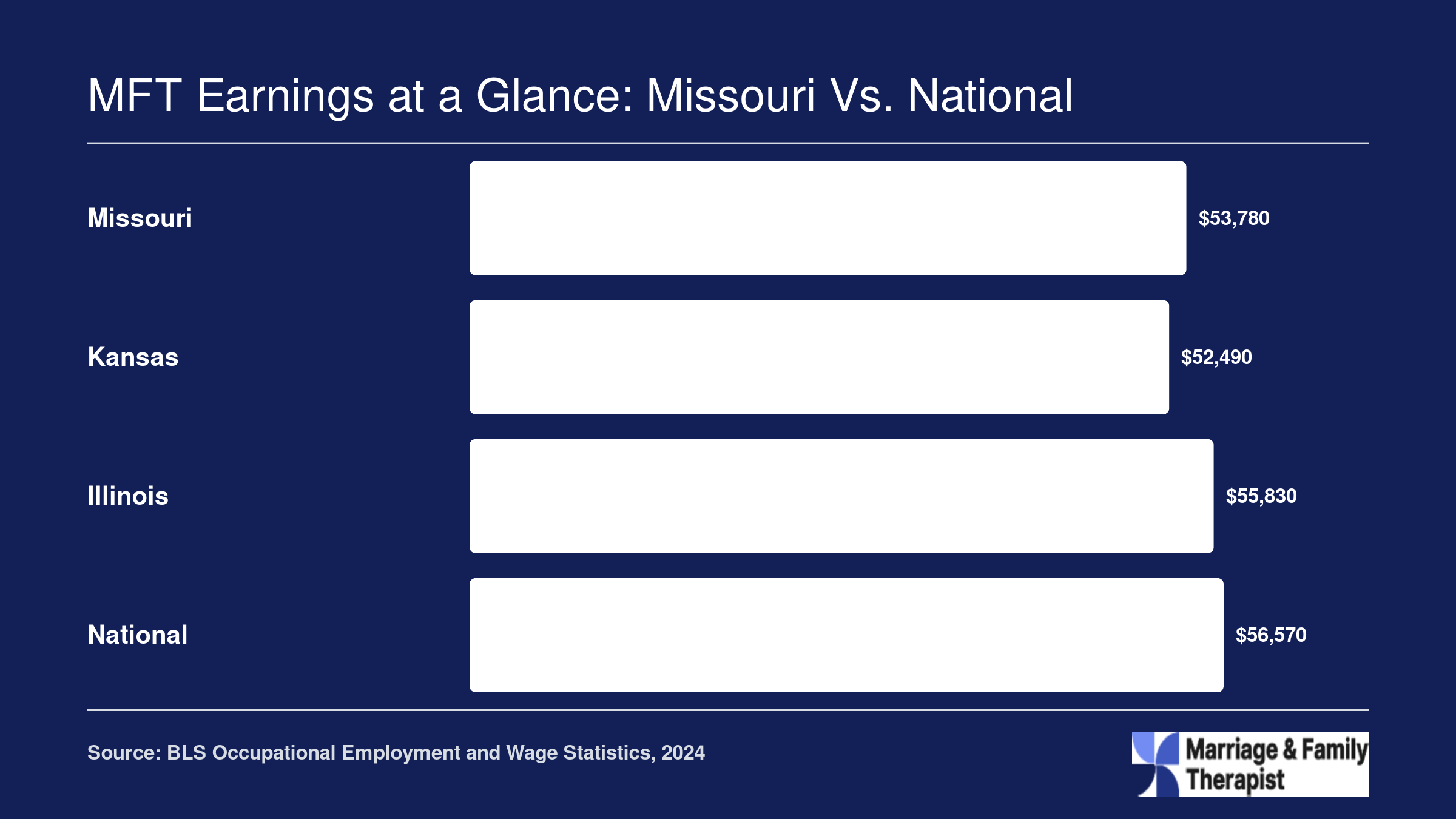
MFT Earnings at a Glance: Missouri Vs. National
Missouri MFT salaries sit slightly below the national median, consistent with the state's lower overall cost of living. With a projected job growth rate of roughly 15% through 2032, demand for licensed marriage and family therapists in Missouri remains strong and competitive with neighboring states.
FAQs About MFT Programs in Missouri
Below are answers to some of the most common questions prospective students ask about MFT degree programs, licensure, and career prospects in Missouri. Each answer draws on the details covered throughout this guide.
What are the requirements to become an LMFT in Missouri?
Missouri requires a graduate degree (master's or doctoral) in marriage and family therapy or a closely related field that includes specified MFT coursework. After graduation, you must complete a minimum of 2,000 hours of supervised clinical experience under an approved supervisor, then pass the Association of Marital and Family Therapy Regulatory Boards (AMFTRB) national examination. Your degree program's accreditation can affect how smoothly these steps go.
Which Missouri MFT programs are COAMFTE accredited?
As of 2026, a limited number of Missouri programs hold Commission on Accreditation for Marriage and Family Therapy Education (COAMFTE) accreditation. Programs at institutions such as Saint Louis University have carried this designation. Because accreditation status can change, always verify current standing directly through the COAMFTE directory before enrolling.
How long does it take to complete an MFT degree in Missouri?
Most master's level MFT programs in Missouri take two to three years of full time study. Part time and hybrid formats may extend the timeline to three or four years. Doctoral programs typically require four to six years. Keep in mind that post-degree supervised clinical hours add roughly one to two additional years before you qualify for full LMFT licensure.
Can I get an online MFT degree and still get licensed in Missouri?
Yes. Missouri accepts degrees from regionally accredited, COAMFTE accredited, or CACREP accredited online and hybrid programs, provided the curriculum meets the state's coursework and clinical practicum requirements. Several nationally recognized online programs are available to Missouri residents. Just confirm the program includes adequate supervised clinical hours, which are typically completed in person at approved sites within the state.
What is the difference between COAMFTE and CACREP accreditation for MFT programs?
COAMFTE is the specialized accreditor for marriage and family therapy programs, while CACREP accredits broader counseling programs, some of which include an MFT concentration. Both are recognized by Missouri's licensing board. COAMFTE programs tend to focus exclusively on systemic, relational therapy training. CACREP programs may offer a wider counseling foundation with an MFT specialization track. Either path can lead to LMFT licensure in the state.
How much do marriage and family therapists make in Missouri?
According to the Bureau of Labor Statistics, marriage and family therapists in Missouri earn a median annual salary in the range of roughly $46,000 to $52,000, which is somewhat below the national median near $58,000. Earnings vary by employer type, geographic area, and experience level. Therapists working in metropolitan areas such as Kansas City and St. Louis, or in healthcare settings, tend to earn toward the higher end of the range.